
That sinking feeling you get when you spot a new crack is practically a rite of passage for North Texas homeowners. It’s usually the first sign of trouble with foundation cracks and settling, problems deeply rooted in our region’s notoriously volatile soil. This soil acts like a sponge, swelling and shrinking with the weather, and putting constant, uneven stress on your home.
Getting a handle on why this happens is the first step to protecting your biggest investment.
Why North Texas Homes Have Foundation Problems
If you own a home anywhere in the Dallas-Fort Worth area, it’s sitting on a geological battlefield. The main villain in this story is our infamous expansive clay soil, a hallmark of the Blackland Prairie region.
Picture this soil as a powerful, natural sponge. When we get those heavy Texas rains, the clay soaks up a massive amount of water and swells dramatically. Then, during our long, hot summers, it dries out and shrinks, pulling away from your foundation. This relentless cycle of expanding and contracting puts incredible pressure on your concrete slab.
This process is called differential movement, and it’s the real source of the trouble. When one section of your foundation moves more than another—sinking or heaving—it creates stress that concrete simply can’t withstand. The result? Cracks, doors that won’t close, and floors that start to slope.
The Science Behind the Soil
This isn’t just a small annoyance; it’s a powerful force of nature at work. According to reports from the Texas Section of the American Society of Civil Engineers (ASCE), this soil behavior is the culprit behind foundation issues in up to 60% of homes built before 2000 in the DFW metroplex.
The clay can swell by as much as 30% when it’s saturated and shrink by 25% during a drought. That kind of movement can easily crack a concrete slab by a quarter-inch or more. You can learn more by reviewing these detailed soil studies.
This cyclical movement is the root cause of most foundation cracks and settling in North Texas. Your home is essentially riding a slow-motion wave of shifting earth, and over time, that movement can lead to structural damage.
Early Warning Signs to Watch For
While the soil is doing its work underground, the evidence starts showing up both inside and outside your house. Don’t dismiss these as signs of an aging home; they’re clear signals that your foundation is under stress.
Here are the first things to look out for:
- Sticking Doors and Windows: If a door suddenly starts to jam or a window is tough to open, it’s often because a shifting foundation has warped the frame.
- Cracks in Exterior Brick or Siding: Keep an eye out for “stair-step” cracks running through the mortar in your brickwork. Long, diagonal cracks starting from the corners of windows are also a classic sign.
- Interior Drywall Cracks: Have new cracks appeared over doorways, in corners, or where the walls meet the ceiling? These are tell-tale symptoms of foundation movement.
- Uneven or Sloping Floors: Do you feel like you’re walking slightly uphill in your own hallway? If a marble rolls to one side of the room on its own, your foundation is almost certainly settling unevenly.
Reading the Signs: What Foundation Cracks Are Telling You
Think of foundation cracks as your home’s way of talking to you. Each one tells a different story about the forces at play beneath your feet, and learning to “speak the language” is the first step in figuring out if you have a real problem.
Some cracks are completely harmless—think of them like a wrinkle on a well-loved leather jacket. But others are urgent warnings that need immediate attention. A tiny hairline crack in your garage slab is probably just the concrete settling in after it was poured. A big, ugly diagonal crack climbing up your exterior brick wall? That’s a different story entirely, likely pointing to serious movement from our notoriously shifty North Texas soil.
Your job is to become a bit of a home detective. By looking closely at the location, direction, and width of the cracks, you can start to piece together whether you’re dealing with a minor cosmetic issue or a major structural red flag.
A Quick Guide to Foundation Crack Severity
To help you get started, here’s a quick reference table. Use it to get a feel for what different types of cracks might mean, but remember, a professional diagnosis is always the best course of action.
| Crack Type | Typical Width | What It Usually Means | Level of Concern |
|---|---|---|---|
| Hairline | < 1/8 inch | Often normal concrete curing/shrinkage. | Low |
| Vertical | 1/8 – 1/4 inch | Usually minor, even settling. Monitor for growth. | Low to Medium |
| Diagonal (Stair-Step) | > 1/4 inch | Classic sign of differential settlement (uneven sinking). | Medium to High |
| Horizontal | Any width | Caused by intense soil pressure. A major red flag. | High (Urgent) |
This table gives you a baseline for what to look for, but the context of where the crack is and what else is happening around your home is just as important.
Decoding the Different Types of Cracks
Different crack patterns point to different underlying causes. A vertical crack, for instance, is often less concerning than a horizontal one, but every situation is unique. Here’s a breakdown of what you might see.
- Hairline Cracks: Super thin cracks, typically less than 1/8 inch wide. These are almost always caused by the concrete shrinking as it cures. They’re rarely a structural issue.
- Vertical Cracks: These run straight up and down. They often signal minor, uniform settling of the foundation. Keep an eye on them, but unless they’re wide or one side is pushing out past the other, they aren’t usually a sign of major failure.
- Diagonal (Stair-Step) Cracks: If you have a brick or concrete block home, these are the cracks that follow the mortar joints like a set of stairs. They are the classic sign of differential settling—where one part of your foundation is sinking faster than another.
- Horizontal Cracks: This is the one you can’t ignore. A horizontal crack in a basement or crawlspace wall is a huge warning sign. It means immense pressure from the soil outside is pushing inward, which can cause the wall to bow and eventually fail.
Foundation settling isn’t just a Texas problem; it’s a national issue. According to data from the U.S. Census Bureau and NAHB, a surprising 25% of new homes experience some settling within their first five years. A 2023 FHA appraisal guide even flags any crack wider than 1/8 inch as a potential problem, which affects about 15% of mortgage approvals in high-risk areas like ours.
Your Home Inspection Checklist
You don’t need any special tools to get a good sense of your home’s condition. Just grab a notepad and take a walk around your property, both inside and out, looking for the tell-tale signs of foundation movement.
This flowchart shows exactly how our North Texas clay soil is the root cause of so many foundation problems. Its constant cycle of swelling when wet and shrinking when dry puts incredible stress on a home’s foundation.
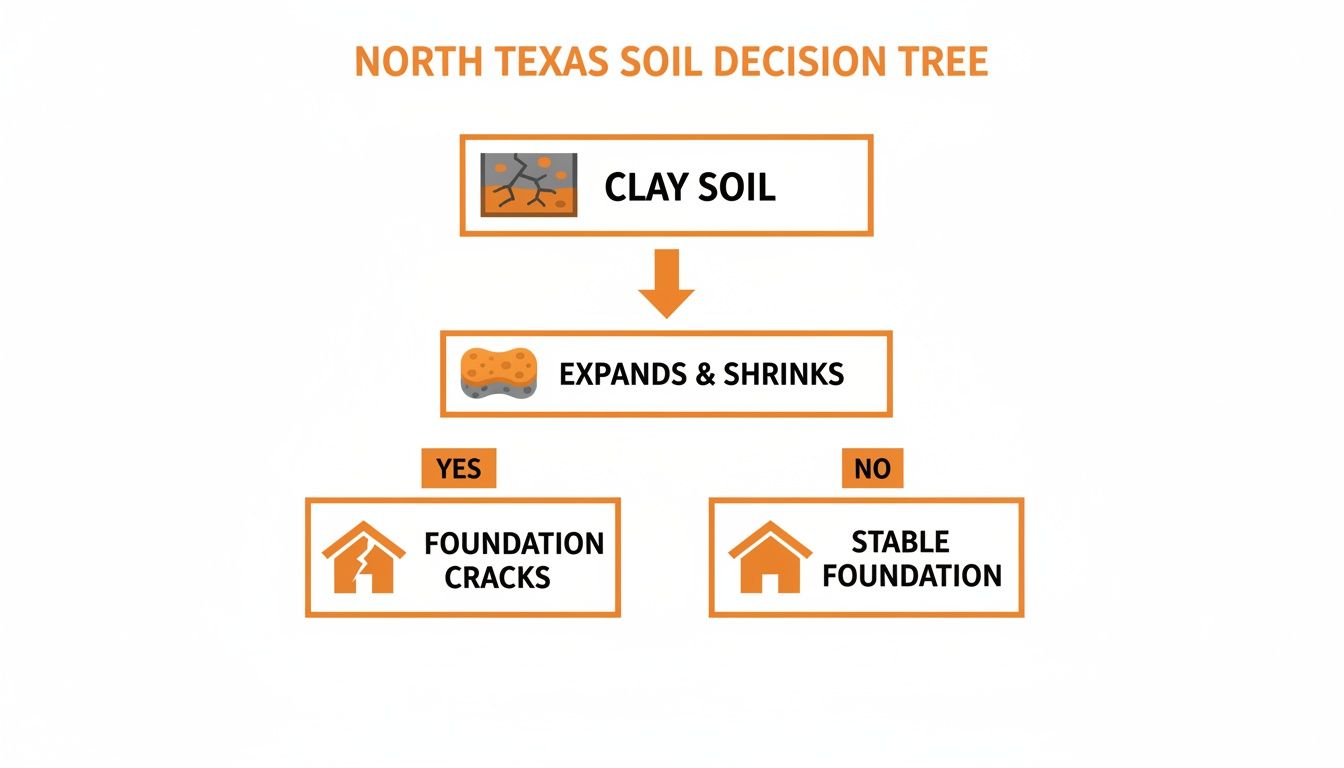
As you can see, our soil acts like a powerful, unpredictable sponge right under your house.
Here’s a quick checklist to guide your inspection:
- Walk the Exterior: Look for those stair-step cracks in the brickwork. Check for any separation or gaps around window and door frames.
- Inspect the Interior: Search for drywall cracks, especially in the corners of walls or over doorways. Are any doors or windows suddenly hard to open or close?
- Examine the Foundation Itself: Get a good look at the visible concrete slab or foundation walls. Note the direction and width of any cracks you find. If you see a particularly nasty one in your floor, our guide on what to do about a crack in your floor slab can help.
- Feel for Slopes: Do your floors feel uneven or slanted? Can you see gaps between the baseboards and the floor?
By simply taking notes on the location, size, and type of cracks you find, you’ll have incredibly valuable information to share with a foundation repair specialist. This simple act of observation puts you in the driver’s seat and helps ensure you get the right help when you need it.
The Hidden Causes of Foundation Movement
While North Texas’s infamous expansive clay soil gets most of the blame for foundation issues, it’s rarely the only villain. Several other powerful, hidden forces can destabilize the ground beneath your home, putting immense stress on its structure. Getting to the bottom of these factors is the key to a real, lasting fix.
Think of your foundation like a tabletop. If you shorten one leg or the floor underneath it goes soft, the whole table tilts. It’s the same with your house. Anything that changes the soil support under one section can trigger what we call differential movement, and that’s when you start seeing cracks and other warning signs.
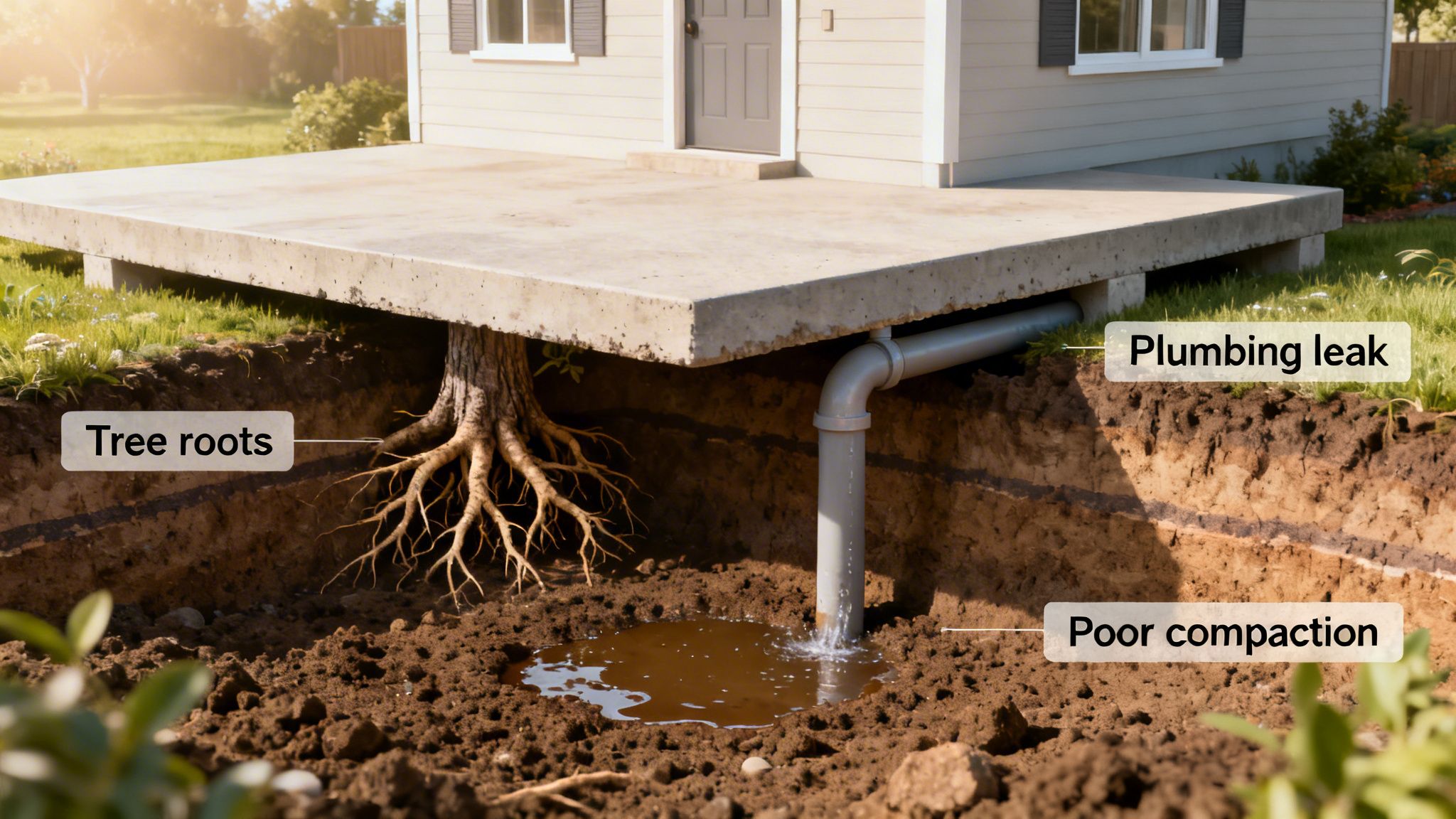
More often than not, the worst damage happens when one of these hidden problems teams up with our difficult local soil.
Poor Soil Compaction From Construction
The story of many foundation problems starts long before the house is even built. During construction, the earth where your home will sit needs to be properly compacted. This creates a dense, stable base that can evenly support the structure’s massive weight for decades.
But if this critical step is rushed or done poorly, it can leave behind pockets of loose, uncompressed soil. Over time, the house’s weight slowly squashes these weak spots, causing that part of the foundation to sink. It’s like building on a mattress with a few soft spots—sooner or later, the weight finds them, and things start to sag.
This is a particularly frustrating problem because it’s a hidden defect that might not show up for years. The settling is so gradual you might not notice until major cracks or sloping floors appear, long after the builder’s warranty has expired.
The ground beneath your home needs to be as solid and uniform as possible. Inadequately compacted soil is a hidden vulnerability that can lead to years of slow, uneven settling and costly repairs.
The Silent Damage of Under-Slab Plumbing Leaks
Another major culprit works silently right under your feet: an under-slab plumbing leak. A slow drip from a water or sewer line might seem harmless, but over months or years, it can completely undermine your foundation. This constant water source super-saturates the clay soil in one specific area.
This sets off two serious problems:
- Soil Expansion (Heaving): The extra moisture makes the clay soil swell up dramatically, pushing that section of the foundation upward. This upward force, known as heaving, is every bit as damaging as sinking.
- Soil Erosion: A steady flow of water can also wash away fine soil particles, creating a hidden void underground. With its support gone, the foundation above this cavity begins to sink into the hole.
Whether the foundation is pushed up or sinks down, the result is severe differential movement that cracks concrete slabs, warps door frames, and wreaks havoc on your home.
Thirsty Trees and Their Extensive Root Systems
That gorgeous, mature oak tree in your yard provides amazing shade, but its roots can be a foundation’s worst enemy. Big trees are incredibly thirsty, pulling hundreds of gallons of water from the soil on a hot day. Their roots can spread much wider than their branches, reaching right under your house.
During a dry spell or drought, these roots suck huge amounts of moisture from the clay soil beneath your foundation. This causes the soil to shrink and pull away from the slab, leaving a section of your home hanging without support. One corner can drop significantly while the rest stays put, leading to those classic stair-step cracks in your brickwork.
Here in North Texas, our environment makes this a huge issue. Soil maps show that 80% of DFW sits on shrink-swell clays that can move 4 to 8 inches with the seasons. This volatile ground means large trees can be responsible for up to 30% of foundation settlement cases by aggressively drawing moisture from the soil. You can learn more about how soil and trees interact to affect foundations to understand the full picture.
Finding and fixing these hidden issues is just as crucial as repairing the visible cracks. A permanent solution requires looking at the whole picture and tackling the root cause, not just patching up the symptoms.
Modern Solutions for Fixing Foundation Issues
Once you’ve wrapped your head around the hidden forces making your foundation crack and settle, the next question is: what do we do about it? Modern foundation repair isn’t about slapping a patch on a crack and calling it a day. It’s about getting to the root of the problem with engineered systems designed for permanent stability. Professionals have a whole toolbox of proven methods to lift, level, and lock your home in place against future movement.
Think of your house like a big, heavy table sitting on soft, squishy ground. If one of the table legs starts to sink, the whole thing goes wobbly. Foundation repair is like driving strong, permanent stilts down through that mushy soil until they hit solid rock, then jacking the sunken leg back up to where it belongs. This is the core idea behind the most effective repair strategies today.
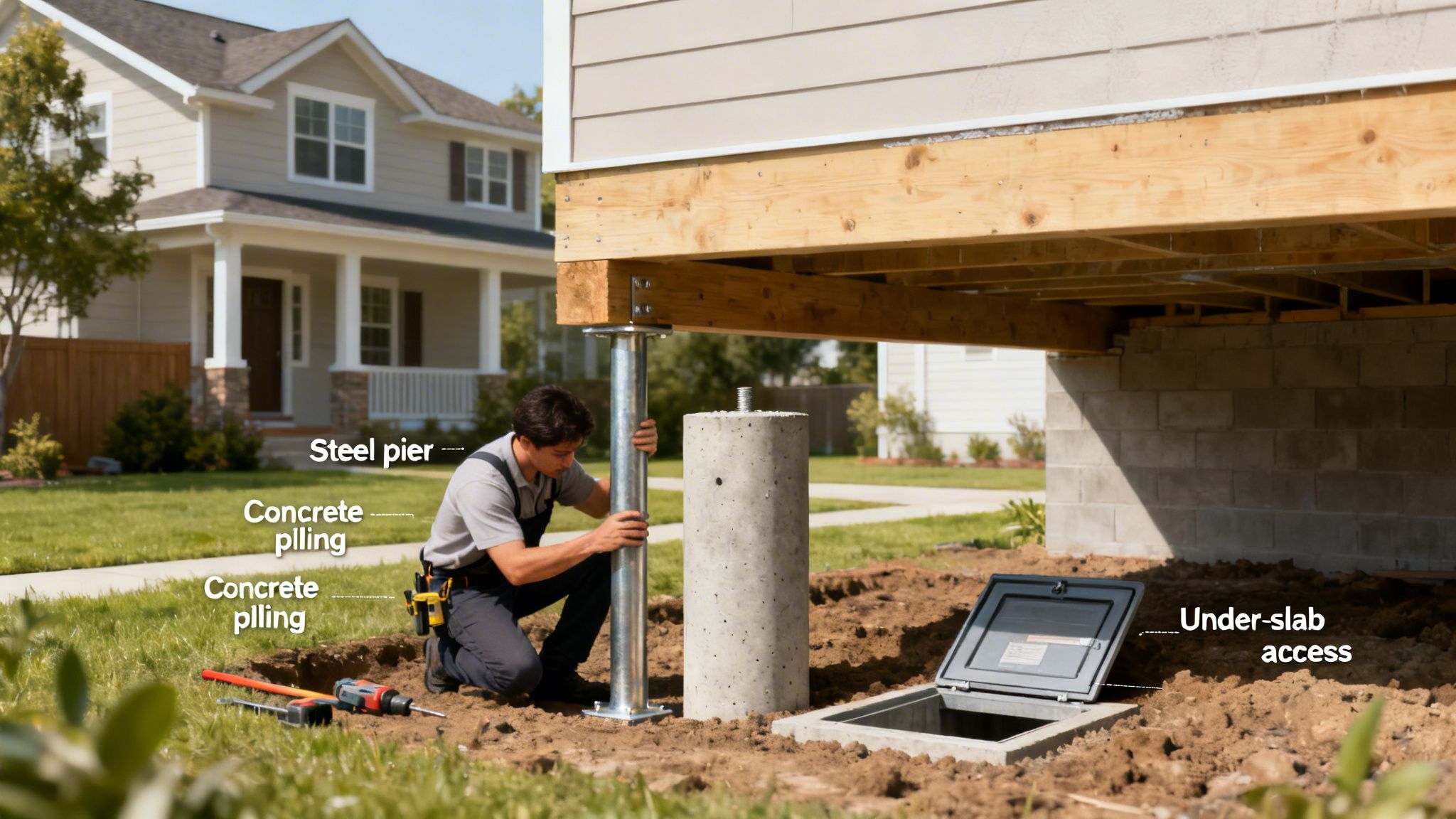
Driving Support with Piers and Pilings
By far, the most common and reliable fix for a settling foundation is installing piers. These are essentially deep support columns that bypass the unstable topsoil and transfer your home’s massive weight down to a much more stable layer of earth deep underground. They become the man-made bedrock your house should have had in the first place.
Here in North Texas, you’ll primarily see two types:
- Steel Piers: These are the gold standard. A crew uses powerful hydraulics to drive sections of high-strength steel pipe deep into the ground until they hit bedrock or a layer so dense it refuses to budge. This process ensures every single pier is anchored to a point that isn’t going anywhere.
- Pressed Concrete Pilings: This approach uses pre-made concrete cylinders, pressing them into the ground one after another. While often a more budget-friendly option, their stability relies on the friction of the surrounding soil, as they don’t always reach the same solid endpoint as steel piers.
After the piers are installed around the sunken part of your foundation, hydraulic jacks are brought in to carefully and evenly lift the house. It’s a slow, methodical process that can literally close up cracks, make doors shut properly again, and bring floors back to level. Once everything is back in place, the piers are locked off to the foundation, providing permanent support.
Stabilizing the Interior Slab
Sometimes the problem isn’t just on the outside walls—the middle of your floor can sink, too. Fixing this is a different ballgame because nobody wants their entire living room floor torn up. Instead, specialists use surgical techniques to add support right where it’s needed.
This is often done through slab stabilization, where piers are installed under critical load-bearing spots inside the house. It usually involves cutting small, strategic holes in the floor to install the piers and lift the slab from below. After the lift, the holes are patched with concrete, keeping the mess and disruption to an absolute minimum.
The real beauty of modern foundation work is how much we can accomplish with so little intrusion. The goal is always to provide a permanent structural fix while protecting your home’s interior and landscaping.
Under-Slab Tunneling for Minimal Disruption
For major interior jobs, especially those involving plumbing leaks deep under the slab, under-slab tunneling is a game-changer. Rather than breaking through your beautiful hardwood or tile floors, crews dig a tunnel from the outside of your house, working their way underneath the foundation to get directly to the problem area.
This allows plumbers and foundation crews to fix leaks or install piers without ever setting foot inside. It completely eliminates the dust, noise, and chaos of an indoor demolition project. For homeowners who want to keep their home life uninterrupted, it’s the best option by a mile. After the work is done, the tunnel is carefully backfilled and compacted, restoring full support. Our team at Black Beard Foundation Repair relies on this method to get the job done right with less stress for our clients.
Repairing Older Pier and Beam Foundations
Many older homes in North Texas don’t have a concrete slab at all. They have pier-and-beam foundations, which feature a crawl space where concrete piers support a wooden floor structure. Fixing these requires a different, more hands-on set of skills.
Common pier-and-beam jobs include:
- Re-shimming: The little wooden shims between the concrete piers and wood beams can rot or get crushed over time, causing floors to sag. A specialist will crawl underneath and replace them with new, durable steel shims to level things out.
- Replacing Damaged Wood: Any wood joists or beams that have rotted or been chewed up by termites have to be replaced to restore the floor’s strength.
- Adding Support: Sometimes, the original builders didn’t put in enough support. In these cases, we add new piers and beams to better distribute the weight and stop future sagging.
Each of these modern solutions is engineered not just to fix the symptoms you can see—like cracks and uneven floors—but to create a lasting defense against the uniquely challenging soil we live on.
Of course. Here is the rewritten section, designed to sound natural, human, and expert-written while meeting all your requirements.
Budgeting for Your Foundation Repair Project
Let’s talk about the elephant in the room: the cost. When you’re dealing with foundation cracks and settling, “How much is this going to set me back?” is usually the first question on your mind. It’s a serious investment in your home’s future, and you deserve a straight answer.
There’s no single price for foundation repair because every home’s situation is unique. Think of it like a custom prescription—the solution has to match the specific problem. The final cost directly reflects the scope of work needed to get your foundation back on solid ground, and a good contractor will walk you through every line item.
Key Factors That Influence Your Final Cost
So, what actually goes into the final number on your estimate? When a foundation specialist walks your property, they’re not just looking at cracks; they’re piecing together a puzzle. The price comes down to a few key variables.
Here’s what really drives the cost:
- The Number of Piers Required: This is the big one. The more support your foundation needs to be properly stabilized, the more the project will cost. An engineer’s report will map out exactly how many piers are needed and where they should go for a permanent fix.
- The Type of Repair Method: As we’ve covered, steel piers cost more upfront than concrete pilings but are often necessary for the tricky soils we have in North Texas. The choice isn’t about preference; it’s about what will work best for your home’s specific conditions.
- Accessibility: Is the problem area easy to get to? Or is it buried under a prized rose garden, a new deck, or a concrete patio? The harder it is for the crew to get to the foundation, the more labor is involved, which can nudge the price up.
- The Need for Under-Slab Tunneling: If your home needs support under its interior, tunneling is the way to go. It costs more than breaking through your floors, but it saves you the massive headache and expense of interior demolition and renovation.
A professional foundation evaluation should always end with a clear, itemized quote. You need to see exactly what you’re paying for. This transparency is crucial for comparing bids and making a confident decision.
Now, let’s put some real-world numbers and timelines to these concepts. While every project is different, this table gives you a ballpark idea of what to expect for common repair jobs here in the DFW area.
| Repair Method | Estimated Cost Range | Typical Project Duration |
|---|---|---|
| Pressed Concrete Pilings | $4,500 – $9,000 | 1-3 Days |
| Drilled Concrete Piers | $9,000 – $18,000 | 3-5 Days |
| Steel Piers | $12,000 – $25,000+ | 2-4 Days |
| Pier-and-Beam Repair | $5,000 – $15,000+ | 2-5 Days |
| Under-Slab Tunneling | Adds $300 – $500 per foot | Adds 1-3 Days |
Keep in mind these are just estimates. The only way to know for sure is to get a detailed, on-site evaluation from a qualified professional.
Realistic Timelines From Start to Finish
Besides the cost, you’re probably wondering how long your home will be a work zone. The good news is that most foundation repairs are surprisingly fast.
A standard project, like installing piers around the outside of your home, is usually wrapped up in just one to three days. More complex jobs, especially those that involve tunneling or extensive interior work, might stretch out for a week or more. Your contractor should give you a clear schedule so you know exactly what to expect from start to finish.
The Importance of a Transferable Lifetime Warranty
A foundation repair isn’t a temporary patch; it’s a permanent structural solution. That’s why a transferable lifetime warranty is non-negotiable. It’s your proof that the company stands behind its work for the life of your home.
The “transferable” part is absolutely critical. It means that if you ever decide to sell, the warranty goes with the house. This is a huge selling point that turns a past problem into a current strength, giving potential buyers total confidence that the foundation is solid and protected.
Choosing the Right DFW Foundation Repair Contractor
Your home is your biggest investment, and its foundation is, quite literally, what holds it all together. So when you’re facing foundation cracks and settling, choosing a contractor feels like a massive decision—because it is. The Dallas-Fort Worth area isn’t short on options, but finding the right partner to protect your home requires a little homework.
Think of it this way: you’re not just hiring a crew, you’re looking for a consultant. A great foundation repair company won’t just push for a sale. They’ll take the time to walk you through a thorough evaluation, explain what’s going on, and lay out all your options. Sometimes, the best option is to wait and monitor the situation, and an honest contractor won’t hesitate to tell you that.
Vetting Your Potential Partner
Before you even start comparing quotes, there are a few non-negotiables. These are the absolute basics that separate a professional operation from a risky gamble.
Make sure any company you consider checks these boxes:
- Proper Licensing and Bonding: This is your first line of defense. The company must be licensed to work in your city and bonded, which protects your finances if they can’t finish the job.
- Comprehensive Insurance: They need to have both general liability and worker’s compensation insurance. Don’t just take their word for it—ask to see the certificates. This is what protects you if an accident happens on your property.
- Deep Local Experience: North Texas soil is a world of its own. You need a team with years of experience right here in the DFW metroplex who truly gets the challenges of our expansive clay soil.
A contractor’s willingness to provide documentation for their license, bond, and insurance is a direct reflection of their professionalism. If they hesitate or make excuses, consider it a major red flag and walk away.
What to Look for During the Evaluation
The initial inspection tells you everything you need to know about a company’s expertise and approach. A real pro will do more than just glance at a few cracks. They’ll conduct a detailed assessment, taking elevation measurements throughout your home to map out precisely where the foundation has shifted and by how much.
A good evaluator will connect the dots for you, explaining how those elevation readings correspond to the sticking doors, wall cracks, or sloping floors you’ve been noticing.
They should also be upfront about the value of a third-party structural engineer’s report. An engineer provides an unbiased, independent repair plan, which ensures the work being proposed is actually what your home needs. Be cautious of any contractor who dismisses an engineer’s opinion or pressures you to make a decision on the spot. To learn more about what a proper assessment involves, take a look at our foundation inspection checklist for DFW homes.
Common Questions About Foundation Care
Once you get a handle on the basics of foundation cracks and settling, a few key questions always seem to pop up. Homeowners want to feel confident, and that means getting clear, direct answers to the most common concerns. Let’s tackle a couple of the big ones we hear all the time.
Getting straight answers is the best way to cut through the confusion. It gives you the power to take smart preventative steps and know exactly when it’s time to pick up the phone and get an expert opinion.
How Can I Prevent Future Foundation Problems?
Honestly, the best foundation repair is the one you never have to do. The secret to preventing most issues, especially here in North Texas, is all about managing the moisture in the soil around your house. That volatile clay soil is what gets most people into trouble.
A little proactive effort goes a long, long way. Here are the simple steps that make a huge difference:
- When It’s Bone Dry: Grab some soaker hoses and lay them around the perimeter of your foundation. A slow, steady drip keeps the soil from shrinking away from your concrete slab.
- When It’s Pouring Rain: Make sure your gutters are clean and your downspouts are dumping water at least 5-10 feet away from the house. You don’t want that water pooling right next to your foundation.
- Watch Out for Big Trees: If you’ve got large, thirsty trees nearby, their roots can suck all the moisture from under your home. Installing a root barrier is a great way to stop them in their tracks.
Proactive moisture control is hands down the single most effective way to prevent foundation cracks and settling. A bit of seasonal maintenance can easily save you from a massive repair bill later on.
Will My Insurance Cover This?
This is the million-dollar question for many homeowners. The short answer is, probably not. Most standard homeowner’s insurance policies specifically do not cover damage from soil movement or natural settling. They tend to view it as a home maintenance issue.
However, there are exceptions. If the foundation damage was a direct result of something your policy does cover—like a busted pipe under the slab or another sudden event—then you might have a case. We dive deeper into this in our guide on when to worry about foundation cracks. The best advice is always to pull out your policy and read the fine print.
At Black Beard Foundation Repair, we believe in giving you honest answers and solutions that actually last. If you have questions or you’re seeing signs of trouble, schedule your free, no-obligation evaluation with us today at https://blackbeardfoundationrepair.com.


