
Finding a crack in your concrete slab can feel like a punch to the gut. But before you panic, take a breath. It doesn’t always signal a foundation catastrophe.
In fact, most minor cracks are just a normal part of the concrete curing process—think of them like the harmless wrinkles you find on a brand-new shirt. The real trick is learning to tell the difference between a simple blemish and a serious warning sign.
What That Crack in Your Floor Slab Really Means
That thin line you spotted on your garage or basement floor is more than just an eyesore; it’s a story written in concrete. A harmless shrinkage crack is like a wrinkle in fabric—it’s just the material settling into its final form. A structural crack, however, is like a tear in that same fabric. It’s a clear sign that powerful forces are pulling your foundation apart.
Here in the Dallas-Fort Worth area, the ground beneath our feet is often the main culprit. Our infamous expansive clay soil acts like a giant, unpredictable sponge. It swells dramatically with rain and then shrinks just as much during our notorious droughts. This constant cycle of movement puts incredible stress on your home’s foundation.
Distinguishing Minor Flaws from Major Flags
The good news? Not every crack means you need to brace for an expensive repair. Many are purely cosmetic. The key is to observe and understand the visual clues that separate a surface-level issue from a symptom of deeper foundation movement.
A structural crack in a floor slab will almost always have a few tell-tale characteristics:
- Width and Growth: Any crack wider than 1/8 of an inch is worth a closer look. If it’s getting bigger over time, that’s a definite red flag.
- Vertical Displacement: Run your hand over the crack. If one side is higher than the other, it means the slab sections are moving independently—a classic sign of trouble.
- Other Warning Signs: A crack rarely acts alone. If it’s paired with other issues like doors that suddenly stick, new cracks in your drywall, or floors that start to slope, you’re likely looking at a systemic problem.
This isn’t just a local issue. The global foundation repair market hit US $3.25 billion back in 2020. Here in North Texas, our expansive clays are responsible for up to 60% of all foundation problems. It’s no surprise that slab cracks show up in over 25% of homes built before 2000, thanks to our intense drought-and-rain cycles. You can learn more about how to protect your slab foundation from these unique challenges.
Your home’s concrete slab is meant to be a single, solid unit. When soil movement forces it to crack and separate, it weakens the very structure that the rest of your house depends on.
By learning to spot these key differences, you can move from a state of worry to one of informed action. Understanding what you’re looking at is the first and most important step toward protecting your home’s value and safety.
What Is That Crack in My Floor Telling Me?
Not all cracks are created equal. Finding a crack in a floor slab can feel alarming, but it can range from a perfectly normal cosmetic issue to a serious warning sign of foundation failure. The first step is learning to read the signs so you know exactly what you’re dealing with.
Think of your foundation as a storyteller. Every crack is a word, and the pattern, width, and location create a sentence that tells you what’s happening deep in the ground beneath your home. Some of those stories are pretty boring; others are urgent warnings that you can’t ignore.
Here in the Dallas-Fort Worth area, that story almost always involves our infamous expansive clay soil. This soil acts like a giant, powerful sponge. It swells up dramatically when it gets soaked with rain and then shrinks just as much during our hot, dry summers. This constant cycle of expansion and contraction puts immense stress on a rigid concrete slab, making it the number one cause of foundation problems in North Texas.
Harmless vs. Concerning Cracks
The good news is that most homes will develop small, superficial cracks over time. This is a natural part of a house settling and isn’t usually something to lose sleep over. The real trick is knowing how to spot the visual cues that separate a minor blemish from a symptom of a much bigger issue.
This infographic gives you a quick visual breakdown to help you start classifying the cracks you see.
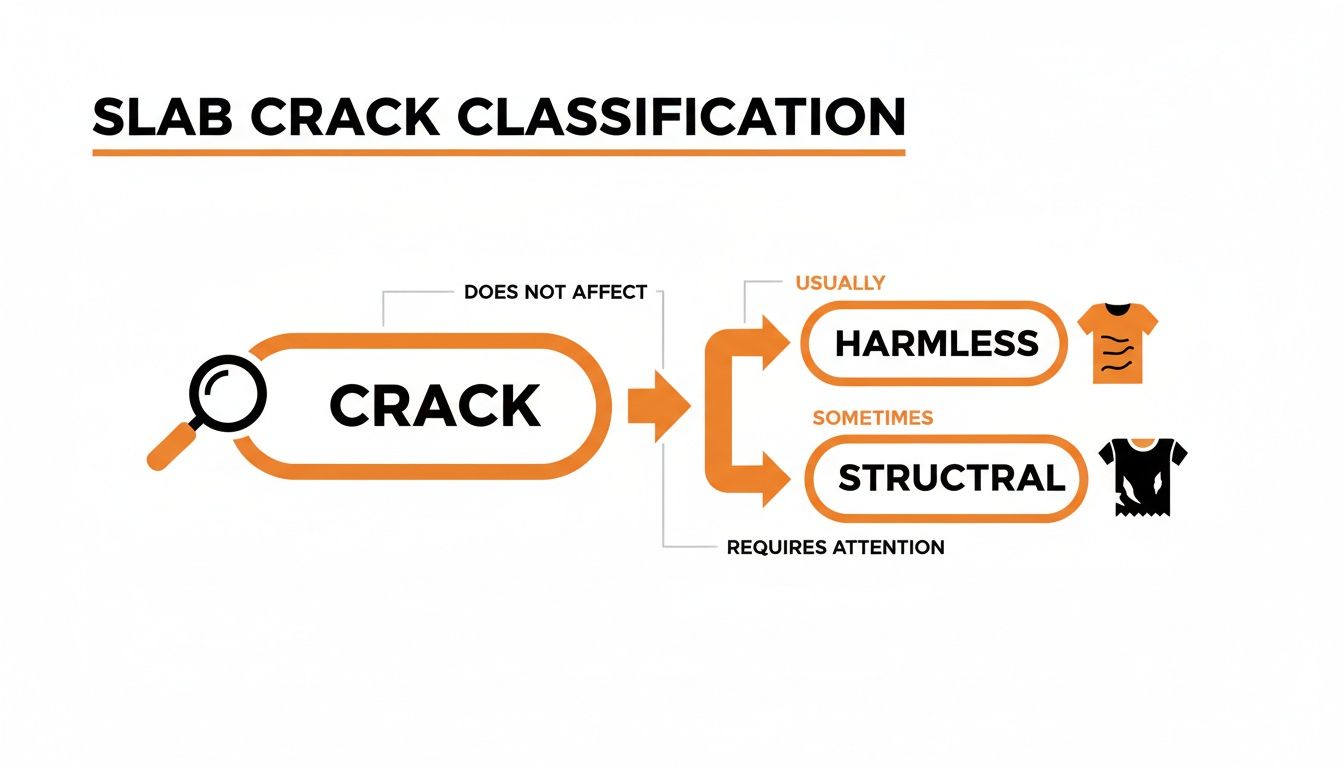
As you can see, while many cracks are no big deal, any that suggest structural movement need a professional diagnosis right away.
Common Types of Slab Cracks
Let’s get a bit more specific. Here are the most common types of cracks you’re likely to find. Each one has a distinct look and a different story to tell, which will help you build a much clearer picture of your foundation’s health.
- Shrinkage Cracks: These are by far the most common and least worrisome cracks. They look like thin, random spiderwebs, are typically hairline-thin (less than 1/8 inch), and appear as the concrete cures and dries out. Think of it as the concrete just settling into its final, hardened state. They’re superficial and don’t go all the way through the slab.
- Settlement Cracks: Now these are the red flags. Settlement cracks happen when the soil under one part of your foundation compacts or washes away, causing that section of the slab to sink. The dead giveaway is that one side of the crack will be higher than the other—what we call vertical displacement.
- Upheaval Cracks: These are the exact opposite of settlement cracks. They’re caused when our expansive clay soil soaks up too much moisture and swells, physically pushing a section of your slab upward. You’ll often see a “hump” in the floor, with cracks radiating out from the highest point.
Here’s the key takeaway: any crack where there’s a change in elevation—whether one side has dropped or one side has pushed up—is a clear sign of active foundation movement. That needs to be addressed.
In the Dallas-Fort Worth metroplex, homeowners are right to be concerned about floor slab cracks. They’re a huge issue here, primarily because our expansive clay soils support roughly 70% of all slab-on-grade foundations. In fact, research shows that a staggering 40% of these cracks are directly linked to poor drainage, which lets water erode the subsoil and cause it to lose volume. You can dig deeper into these regional foundation repair market dynamics for more context.
Slab Crack Identifier Chart
Use this guide to quickly understand the visual cues of different floor slab cracks, their common causes in North Texas, and the recommended course of action.
| Crack Type | Visual Appearance | Primary DFW Cause | Risk Level | Recommended Action |
|---|---|---|---|---|
| Shrinkage Crack | Thin, web-like, random patterns. Less than 1/8″ wide. No vertical displacement. | Normal concrete curing and drying. | Low | Monitor for changes. A cosmetic filler can be used if desired, but it’s not structurally necessary. |
| Settlement Crack | Wider than 1/8″. One side is lower than the other. Often runs across the slab. | Soil compaction, erosion from poor drainage, or severe soil shrinkage during a drought. | High | Immediate professional evaluation is needed to diagnose the cause and stabilize the foundation. |
| Upheaval Crack | Often forms a “hump.” Cracks radiate from a high point. Can be wide or narrow. | Swelling of expansive clay soils due to plumbing leaks or excessive rainfall. | High | Requires a professional evaluation to find the moisture source and correct the foundation. |
This chart is a great starting point, but every home is unique. If you see a crack that falls into the “High” risk category, or if a smaller crack is actively growing, it’s always best to have a professional take a look.
How to Properly Assess and Monitor a Slab Crack
So, you’ve spotted a crack in your concrete slab. It’s one thing to see it, but it’s another thing entirely to understand what it’s doing over time. Before you rush to call a professional, taking a few simple steps to measure and monitor the crack can give you—and us—a ton of valuable information. This simple act turns you from a worried homeowner into an informed partner in diagnosing the problem.
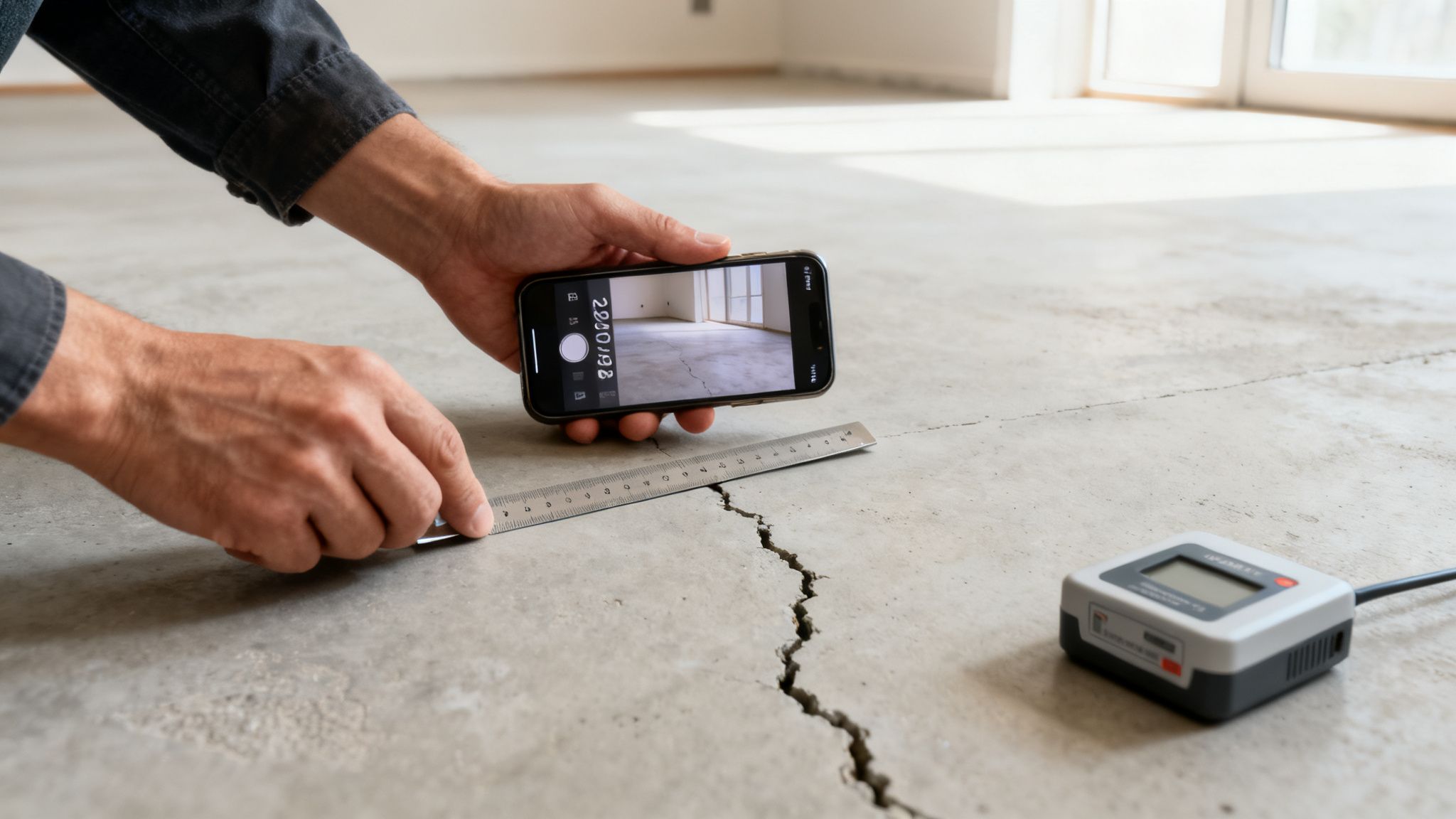
Think of yourself as a detective gathering clues for the case. The more data you can collect on how that crack is behaving, the clearer the big picture becomes. This initial legwork helps an expert quickly tell the difference between a harmless, old crack that isn’t going anywhere and an active one that signals an ongoing structural issue.
Your Step-by-Step Monitoring Guide
The good news is that you don’t need any fancy, expensive equipment to monitor a slab crack. All it takes is a few common household items and a little bit of consistency to build a detailed record of any changes.
Here’s a simple, three-step process to get you started:
- Measure and Mark: Grab a ruler or tape measure and jot down the crack’s width at its widest point. Also, measure its total length. Then, take a pencil or a permanent marker and make small marks at each end of the crack. This way, you’ll know immediately if it starts to grow.
- Take Dated Photos: A picture is worth a thousand words, especially here. Snap clear, well-lit photos of the crack. Try to take them from the same angle each time and include something for scale, like a coin or the ruler itself. Most importantly, make sure you know the date of each photo.
- Document Everything: Start a simple log in a notebook or a notes app on your phone. Every time you check, record the date, the measurements, and any other observations. This creates a timeline that’s incredibly helpful for spotting trends.
By doing this, you’re turning a vague worry into hard data. You’re no longer just “seeing a crack”; you are actively tracking specific metrics that will reveal its true nature. To get a better feel for what the pros look for, you can learn more about the details of a comprehensive foundation inspection.
Upping Your Monitoring Game
For cracks that seem a bit more concerning, you can get more precise with your tracking. A simple but surprisingly effective trick is to place a piece of masking tape across the crack. If that tape tears or gets wrinkled, you know for sure there’s been movement.
If you want to get more scientific, you can buy a crack monitoring gauge online or from a hardware store. These are simple plastic devices that you place over the crack. They have a grid that can show you movement down to the millimeter, providing undeniable proof of whether a crack is active or dormant.
A static, unchanging crack is often a sign of a past event that has since stabilized. An actively growing crack, however, indicates an ongoing problem with the soil or structure that is putting your foundation under continuous stress.
Critical Warning Signs to Watch For
As you’re monitoring, you need to keep an eye out for specific red flags that signal a more urgent problem. These symptoms often show up alongside a structural crack in a floor slab and suggest the issue is affecting more than just the concrete.
Be on high alert if you notice any of the following:
- Active Widening or Lengthening: Your photo and measurement log clearly shows the crack is getting bigger over time.
- Vertical Displacement: This is a big one. One side of the crack is now higher than the other, creating a trip hazard.
- Sticking Doors and Windows: Doors that suddenly jam in their frames or windows that are a pain to open and close are classic signs of foundation shifting.
- New Drywall Cracks: Keep an eye out for new diagonal cracks appearing on your interior walls, especially starting from the corners of door and window frames.
- Sloping Floors: If you drop a marble or a golf ball on the floor and it consistently rolls toward one part of the room, your slab is likely no longer level.
Spotting these signs doesn’t mean your house is about to fall down. It simply means the forces acting on your foundation are serious enough to warrant immediate professional attention. The data you’ve gathered will be a huge head start for an expert, helping them pinpoint the root cause and recommend the right fix.
Proven Repair Solutions for Structural Slab Cracks
Once we’ve confirmed a structural problem, the conversation shifts. We’re no longer asking if you need a repair, but rather how we’re going to fix it for good. This is where engineering and hard-won experience come together to provide a permanent solution for that crack in floor slab. We’re not just patching a symptom; we’re going straight to the source—the unstable soil—to restore the stability of your entire home.
Think of it this way: if a car’s frame is bent, you wouldn’t just fix a dent in the door and call it a day. The real issue is the frame. Professional foundation repair is all about realigning that structural “chassis,” making sure your home is properly supported for decades to come.
Stabilizing the Foundation with Piers
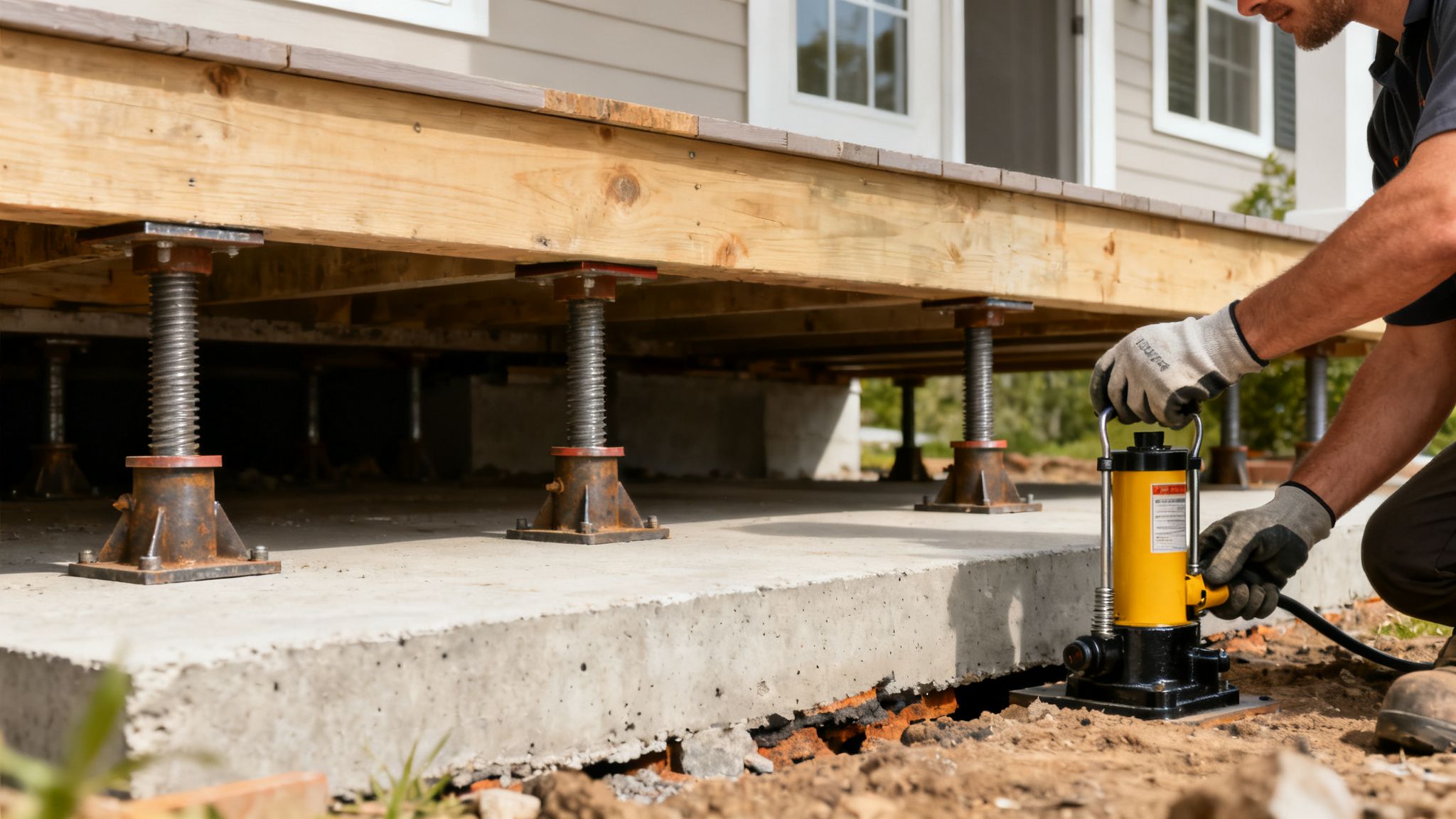
By far, the most reliable way to fix a settled foundation is by installing piers. These are heavy-duty support columns that we drive deep into the earth, bypassing the volatile clay soils near the surface that cause all the trouble. They act like stilts, transferring the immense weight of your home down to a solid, load-bearing layer of soil or bedrock that doesn’t shrink or swell.
Here in the Dallas-Fort Worth area, we primarily rely on two types of piers:
- Steel Piers: Made from high-strength steel, these piers are hydraulically driven into the ground, section by section, until they hit solid rock or a soil layer so dense it refuses to budge. They offer incredible strength and are installed with minimal digging.
- Concrete Piers: This method involves drilling a deep shaft, lowering a steel rebar cage for reinforcement, and then filling it with concrete. They are certainly effective, though they typically require more time and heavier equipment to install.
No matter which type is used, the job is the same: create an unshakeable support system that can lift the sunken parts of your foundation back where they belong. You can see how we put these systems to work by exploring our foundation repair services.
Piering doesn’t just stop your foundation from sinking further. It provides the muscle needed to carefully and precisely lift it back into place. This is what closes up those ugly structural cracks, gets your doors to shut properly again, and levels out your floors.
The House Leveling Process
With the piers securely in place, the real magic begins: the house leveling process. This isn’t a quick, forceful jack-up. It’s a slow, synchronized, and meticulous operation. We place powerful hydraulic jacks on top of each pier, all controlled by a central manifold that ensures even pressure distribution.
Our crew chief keeps a laser-like focus on elevation readings across the entire foundation, directing the team to make tiny, incremental adjustments. The goal is to lift the settled areas gently and uniformly to avoid putting any new stress on the structure. This delicate dance continues until your foundation is back to its original, level plane.
It’s like a team of movers trying to lift a priceless, fragile antique. If one person lifts their corner too fast, the whole thing could crack. House leveling demands that same coordinated effort, ensuring the entire structure rises as one solid unit.
Under-Slab Tunneling for Minimal Disruption
Often, the problem isn’t just around the edges of your home; piers are needed under the interior of the foundation, too. Years ago, this meant one thing: jackhammering through your living room floor. It created a massive mess, filled your home with dust, and often forced you to move out during the repair.
Thankfully, those days are over. Under-slab tunneling is a much smarter, cleaner approach. Instead of coming through your front door, our crews hand-dig small tunnels from the outside of your home, working their way underneath the slab to the exact spots where interior support is needed.
The advantages of this method are huge:
- No Interior Mess: Your floors, furniture, and daily routine are completely untouched. All the work happens outside.
- Faster and Cleaner: We avoid all the demolition and reconstruction of your concrete floors, which saves a ton of time and keeps your home dust-free.
- Protects Your Utilities: Tunneling gives us a direct view of the plumbing and electrical lines under your slab so we can work around them safely.
By opting for tunneling, you get the exact same robust, permanent repair without having to turn your house into a construction zone. It’s a perfect example of how modern foundation repair respects both the integrity of your home and your peace of mind.
Navigating Repair Costs, Timelines, and Warranties
Alright, so a structural engineer has confirmed you have a foundation issue. The next thoughts that probably pop into your head are: “How much is this going to set me back?” and “How long is my house going to be a mess?”
These are completely normal questions. Getting a handle on the financial and logistical side of foundation repair is just as crucial as understanding the engineering. It helps you budget, plan your life, and move forward with confidence.
The truth is, there’s no flat rate for fixing a crack in a floor slab. The cost is tied directly to the scale of the problem. A minor fix needing just a couple of piers under a single corner is a world away from a major settlement issue that requires supporting the entire footprint of your home.
Understanding Repair Costs in DFW
Here in the Dallas-Fort Worth area, most homeowners find that foundation repair costs land somewhere between $5,000 and $25,000, though some extensive jobs can go higher. Several key factors determine where your project will fall on that spectrum:
- Number of Piers Needed: This is the biggest variable. More support points mean more materials and labor, which drives up the cost.
- Type of Piers Used: Steel and pressed concrete piers come with different price points for both materials and the installation process.
- Accessibility: Is the work area easy to get to? Tight spaces, extensive landscaping, or large concrete patios can add to the labor hours needed.
- Under-Slab Tunneling: While tunneling is a fantastic way to save your interior floors from being torn up, it’s a labor-intensive process that adds to the overall project cost.
We’re seeing more of these repairs due to our region’s older housing stock and wild climate swings. In fact, the U.S. foundation repair market is projected to reach $3.57 billion by 2026. Letting a serious crack go unaddressed can tank your home’s value by 15-25%. While a $10,000 to $20,000 repair bill in DFW might seem daunting, it’s a vital investment to protect your property’s safety and market value. You can explore the foundation repair service market trends to see the full industry scope.
Project Timelines and What to Expect
Many people imagine foundation repair as a drawn-out nightmare that turns their home into a construction zone for weeks on end. I’m happy to report that’s rarely the reality. Most projects wrap up much faster than you might think.
A standard job involving pier installation and leveling your home typically takes just 2 to 5 days to complete. The exact timeline depends on how many piers we’re installing and whether we need to tunnel underneath. Our crews are focused on working efficiently to get your life back to normal as quickly as possible.
The most crucial part of any foundation repair isn’t just the work itself—it’s the peace of mind that comes after. A strong warranty is your assurance that the solution is built to last.
The Power of a Lifetime Structural Warranty
Any foundation repair company worth its salt will stand firmly behind its work with a solid warranty. At Black Beard Foundation Repair, we back our piering systems with a lifetime transferable structural warranty. This is your ultimate protection.
What does that mean for you? If the sections of the foundation we repaired ever move or settle again, we’ll come back and make adjustments at no cost to you. And because the warranty is transferable, it becomes a huge asset if you ever decide to sell your home, giving the new owners the exact same security. It’s not just a piece of paper; it’s our promise to the long-term stability of your home.
Your Action Plan for Dealing with a Floor Slab Crack
Finding a crack in your home’s foundation can be unsettling, to say the least. It’s easy to jump to worst-case scenarios, but you’re now equipped with the knowledge to handle this situation logically. Let’s walk through a clear, methodical plan to get you from discovery to resolution.
Think of yourself as a detective gathering clues. Your job isn’t to solve the whole case on your own, but to collect the right information so a professional can give you a fast, accurate assessment. The more details you can provide, the better.
Your Four-Step Checklist
Not sure where to start? Don’t worry. Just break the process down into these four simple steps. This checklist will guide you from that first “uh-oh” moment to a solid solution, making sure nothing important gets missed.
- Observe Without Panic: Your first reaction matters. See the crack, acknowledge it, but remember what you’ve learned—many are perfectly normal. Take a breath and just look at it for a moment.
- Document Everything: Now, start a log. Grab a tape measure and note the crack’s width and length. Snap a few clear, dated photos on your phone. This creates a baseline, which is essential for tracking any changes over time.
- Look for Other Warning Signs: A single crack rarely tells the whole story. Take a walk around your house. Are doors suddenly sticking? Do windows jam when you try to open them? Have any new cracks appeared in the drywall around door or window frames? Jot down anything that seems off.
- Schedule a Professional Evaluation: This is the most critical step. You’ve gathered your initial evidence, and now it’s time to bring in an expert to connect the dots. Only a professional can truly diagnose the root cause and tell you what’s going on beneath your home.
The single most effective action you can take is to get an expert opinion. A free, no-obligation evaluation provides a definitive diagnosis and a clear path forward, eliminating guesswork and anxiety.
Protecting your home’s structural integrity, its safety, and its value all starts with this simple action. If you’ve found a crack or noticed any of the related warning signs we’ve discussed, don’t wait for the problem to get worse. It’s time to take the decisive next step.
Got Questions About Cracks in Your Concrete Slab? We’ve Got Answers.
When you spot a crack in your concrete floor, a dozen questions probably pop into your head. It’s a common experience, and we hear the same concerns from homeowners all the time. Let’s get straight to the point and answer the most frequent questions we encounter.
Our goal here is to give you some real clarity and help you figure out what to do next. We’ll touch on everything from those tiny cracks in the garage to whether or not a quick DIY patch will actually work.
Are Hairline Cracks in My Garage Floor a Big Deal?
Most of the time, no. Those super-thin, wispy cracks—the ones less than 1/8 inch wide—are usually just a normal part of the concrete curing process. Think of them as concrete’s version of stretch marks. They happen as the slab dries and settles, and they’re typically not a threat to your home’s structure.
However, you can’t just ignore them completely. Keep an eye on them. If you notice a hairline crack starting to get wider, longer, or—and this is a big one—if one side of the crack becomes higher than the other, that’s a red flag. It could be a sign that the soil underneath is starting to shift. Given the notoriously active clay soils here in North Texas, it never hurts to get a professional opinion on any crack that’s changing.
If a Crack Is Structural, Will It Get Worse on Its Own?
Almost certainly, yes. If a crack is caused by foundation movement, it’s a symptom of a much bigger problem. The real culprit is the unstable soil beneath your home, which is constantly swelling when it rains and shrinking during our DFW droughts. That cycle puts enormous stress on your slab.
Leaving a structural crack in a floor slab alone is asking for trouble. It’s a clear sign that part of your foundation is settling, and that settlement will likely continue. Soon you’ll start seeing other classic signs like doors that stick, windows that are hard to open, and new cracks showing up in your drywall. The best (and cheapest) approach is to tackle the root cause early before a small issue snowballs into a massive, costly repair.
A quick heads-up on DIY fixes: Slapping some epoxy or concrete filler on a crack is purely cosmetic. It might hide the problem for a little while, but it does absolutely nothing to fix the unstable ground that caused it.
The foundation will keep moving, and that crack will either reappear right through your patch job or new ones will pop up nearby. If you have a crack that’s growing or you see other signs of foundation issues, the only real fix is a professional repair that stabilizes the foundation itself.
How Much Will It Cost Just to Have Someone Look at It?
This is a question that stops a lot of people from making the call, but it shouldn’t. Any trustworthy foundation repair company in the Dallas-Fort Worth area knows that you need a clear diagnosis before you can even think about repairs. That initial inspection should be about getting you answers, not costing you money.
Here’s what you should expect from a professional evaluation:
- No-Cost Inspection: Reputable companies, including Black Beard Foundation Repair, offer a thorough foundation evaluation completely free of charge.
- A Real Assessment: This isn’t just a quick walk-through. A specialist should be taking detailed elevation readings across your slab to see exactly what’s going on.
- An Objective Diagnosis: The entire point is to give you the facts—an unbiased assessment of your foundation’s health and a clear plan of action, if one is even needed. There should be absolutely no pressure to buy anything.
This free service gives you the expert data you need to make a smart decision about your home. It’s all about protecting your property’s integrity and value.
If you’ve spotted a crack that has you worried, or if you’re seeing any other signs of foundation trouble, the smartest next step is to get an expert opinion. Black Beard Foundation Repair provides free, no-obligation evaluations across the entire Dallas-Fort Worth area. We’ll give you a straight, honest assessment of your home’s foundation.
Ready for some peace of mind? Schedule your free evaluation today.