
When your house rests on an elevated structure, pier and beam foundation repair is all about leveling and stabilizing it. This usually means we’re adjusting the existing piers, swapping out damaged wood beams, or adding brand new supports to get things back on track. For homeowners in Dallas-Fort Worth, this is a common conversation, thanks to our infamous shifting clay soils. Tackling these repairs early is crucial to stop bigger headaches like sloping floors and cracked walls from developing.
What Is a Pier and Beam Foundation
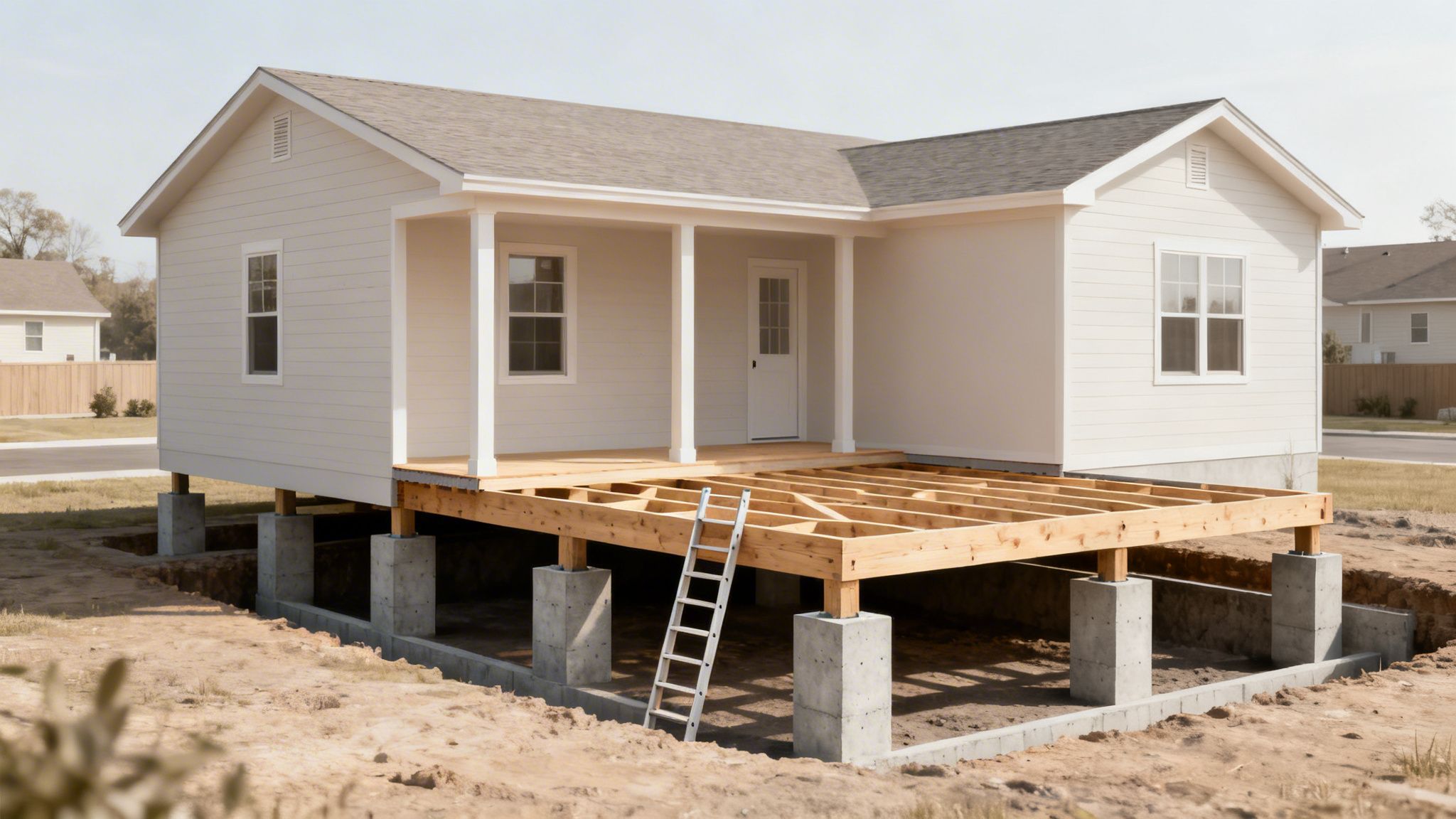
Think of a pier and beam foundation like a sturdy, elevated deck that your entire house is built on. Instead of sitting directly on the dirt, this classic construction method creates a gap between the ground and your home’s floor. That gap is what we call the crawl space.
The whole system is a team effort. It starts with concrete piers sunk deep into the ground, acting like strong legs. These piers support heavy-duty wood or steel beams that create the main skeleton. Then, floor joists are laid across those beams, forming the platform for your subfloor. It’s a tried-and-true approach.
Why This Design Thrives in North Texas
You’ll find this foundation style all over older neighborhoods in Dallas, Fort Worth, and the surrounding towns for one big reason: our notorious expansive clay soil. This soil is a real character. It swells up like a sponge when it gets wet and shrinks and cracks during our brutal summers.
All that movement puts a tremendous amount of stress on a house. This is where a pier and beam foundation really shines.
The genius of a pier and beam system is its ability to “flex” with the soil’s movement in a way a rigid concrete slab just can’t. This inherent flexibility makes adjustments and repairs much less invasive and more precise.
The Anatomy of Support
Let’s break down the “skeleton” holding up your house. Each component has a critical job:
- Piers: These are the strong columns that transfer the entire weight of the house down into stable ground. They can be made of anything from concrete blocks to poured concrete footings.
- Beams: Lying horizontally on top of the piers, these are the heavy lifters. They take the load from the house and spread it evenly across all the piers.
- Joists: These are smaller beams running perpendicular to the main beams. They’re the final layer of support that your home’s actual flooring rests on.
The crawl space this system creates, usually anywhere from 18 to 36 inches high, isn’t just empty space. It’s a game-changer. It gives plumbers, electricians, and HVAC technicians easy access to your home’s guts. More importantly for us, it means foundation repair specialists can work underneath the house without tearing up your floors or breaking through concrete. Getting a handle on this basic setup is the first step to understanding what can go wrong and how we fix it.
Signs Your Foundation Is in Trouble
Your home can’t talk, but it will definitely tell you when its foundation is struggling. These aren’t just little cosmetic quirks; they’re symptoms of bigger issues brewing down in the crawl space. Learning to spot these warning signs early can save you a ton of headache and money on more serious pier and beam foundation repair later on.
Think of yourself as a home detective. You spot a small clue—like a door that suddenly sticks—and it leads you to a much bigger discovery. When it comes to foundations, that sticky door is often a direct result of the entire doorframe shifting because the floor beneath it is sinking or heaving.
These problems almost never happen overnight. They develop slowly as the notorious expansive clay soil here in North Texas swells with rain and shrinks during dry spells, pushing and pulling on the piers and beams that hold up your home. Catching those first subtle hints is the secret to getting ahead of the problem.
Clues Inside Your Home
The first place you’ll probably notice something is off is inside your house. These are the daily annoyances that are so easy to write off, but you really shouldn’t. They’re the direct result of movement happening right under your feet.
Keep an eye out for these common red flags indoors:
- Sloping or Uneven Floors: Ever feel like you’re walking slightly uphill in your own hallway? Or maybe when you drop a marble, it always rolls to the same corner of the room. This is a classic sign that the piers in one area have settled, causing that part of the floor to dip.
- Doors and Windows That Stick: A door that worked perfectly last year but now jams in its frame is a huge tell. It means the frame itself has been twisted out of square because the foundation is no longer level. The same thing goes for windows that suddenly become a chore to open or close.
- Cracks in Walls and Ceilings: Don’t just paint over new cracks in your drywall or plaster. Look especially for zig-zagging or diagonal cracks shooting out from the corners of doors and windows—these are often a direct pointer to foundation settlement. You can learn more by checking out our detailed guide on what different types of foundation cracks mean.
These signs are your home’s early warning system. They’re the most visible proof you’ll get that the structure is under stress and needs a closer look.
To make it easier, here’s a quick checklist you can use to spot common foundation problems inside and outside your home.
Quick Guide to Foundation Warning Signs
| Symptom Location | What to Look For | What It Could Mean |
|---|---|---|
| Interior | Doors/windows that jam or won’t latch. | The frame is twisted from an unlevel foundation. |
| Interior | Sloping, sagging, or bouncy floors. | Support piers have settled or beams have deteriorated. |
| Interior | Cracks in drywall, especially over doors/windows. | The house frame is shifting due to foundation movement. |
| Exterior | “Stair-step” cracks in brick or masonry. | A section of the foundation is sinking, pulling the wall apart. |
| Exterior | Gaps between the chimney and the house siding. | Significant foundation settlement is causing separation. |
| Exterior | Gaps around window frames or doors. | The foundation has moved enough to create openings. |
Just remember, one sign might not be a major issue, but if you’re ticking off several boxes on this list, it’s definitely time to investigate further.
Problems on the Outside
While the signs inside are often more obvious, a quick walk around your property can tell you even more about your foundation’s health. What you find on the outside often confirms the suspicions you had from the inside.
A key place to look is your home’s brickwork or siding. Get up close and look for those distinctive stair-step cracks in the mortar between bricks. These cracks are a dead giveaway that one part of the foundation has dropped lower than another, literally pulling the wall apart.
A pier and beam foundation is one big connected system. When a single part fails—like a rotting beam or a sinking pier—it starts a chain reaction that travels up through the floor, into the walls, and across the ceilings. That crack you see in your living room wall actually started down in the crawl space.
Finally, look for gaps. See if there’s any separation between your window frames and the brick, or check where the chimney meets the side of the house. If it looks like it’s pulling away, that’s a sign of serious movement. Catching these clues early is your best bet for a straightforward and effective pier and beam foundation repair.
How Pier and Beam Foundations Are Repaired
When people hear “foundation repair,” they often picture a huge, disruptive mess. But with pier and beam foundations, the process is usually much more straightforward and less invasive than you might think. Most of the work happens right in the crawl space, meaning we can get the job done without turning your life upside down.
The main goal is always the same: get your home stable, secure, and level again.
What we do really depends on what we find during the inspection. A sinking corner needs a totally different game plan than a floor that’s sagging in the middle of a room. A good contractor will pinpoint the real cause—whether it’s failing piers, rotting wood, or our notorious DFW soil—and then map out a repair plan that fixes that specific issue.
It’s like being a good car mechanic. You don’t pull the whole engine out when all you need is a new spark plug. We find the exact point of failure and apply the right fix.
The First Step: Reshimming and Adjustments
More often than not, the simplest fix is the best one. If you’ve got minor settling or floors that have started to feel a bit bouncy, the first thing we look at is reshimming. The process is exactly what it sounds like: we add small, tough wedges called shims (either steel or wood) between the pier and the beam to close any gaps.
Think of it like putting a folded napkin under a wobbly restaurant table to stop it from rocking. It’s that simple. Our crew gets into the crawl space, uses hydraulic jacks to gently lift the beams just enough, and slides in new shims to make everything tight and level again.
This is probably one of the most common repairs we do here in North Texas. In fact, reshimming is often the most cost-effective solution for the settling caused by our expansive clay soils, which are responsible for up to 70% of foundation issues in the state. We can often get this done in a day, but because the soil is always moving, you might need it touched up every 3-5 years.
The warning signs below—like wall cracks and sloped floors—are exactly the kinds of things that tell us a simple adjustment might be needed.
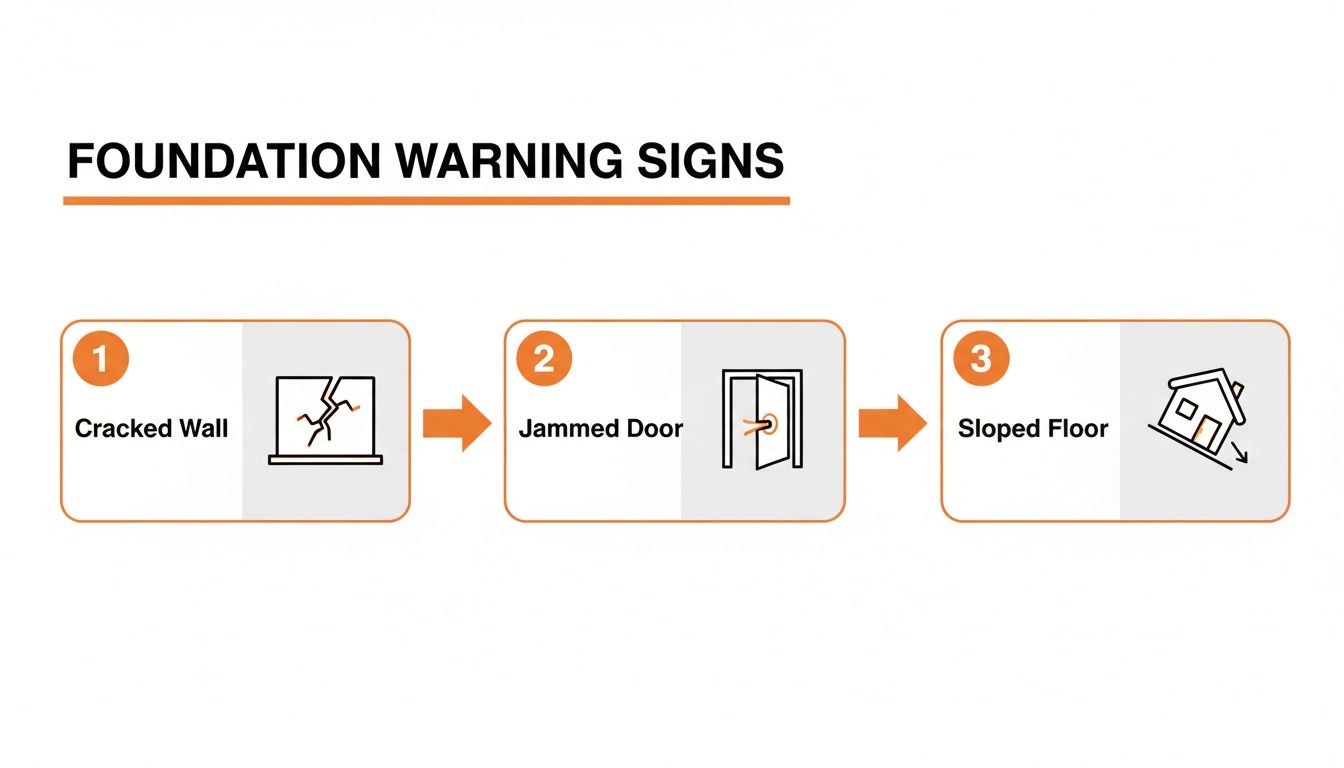
It’s amazing how a tiny crack in the drywall can be the first clue to an underlying foundation issue that needs a little bit of shimming.
Replacing Damaged Wood Components
Moisture is the number one enemy of a pier and beam foundation’s wood structure. When you have poor ventilation, a slow plumbing leak, or bad drainage outside, the humidity in your crawl space skyrockets. This leads to wood rot, which weakens your floor joists and support beams over time. Of course, termites and other pests love these conditions, too.
When we find wood rot or insect damage, shims won’t cut it. The compromised wood has to go.
Here’s how we tackle that:
- Temporary Support: First, we set up temporary posts to hold the weight of the house around the damaged section.
- Removal: We then carefully cut out the rotten or eaten-away wood and get it out of the crawl space.
- Installation: A brand new, pressure-treated beam or joist—which is built to resist moisture and pests—is cut to fit perfectly and installed.
- Load Transfer: Finally, we gently transfer the home’s weight from our temporary supports back onto the new, permanent wood.
This is a surgical repair that puts strength right back where it’s needed, stopping any further sagging in its tracks.
Installing New Piers and Underpinning
Sometimes, the problem isn’t with the shims or the wood—it’s the piers themselves. They might be too far apart, weren’t built right in the first place, or they’ve simply sunk into our shifting clay soil. When the original piers just can’t do their job anymore, we have to add new ones.
A home’s foundation is only as strong as its weakest point. Adding new piers is like bringing in reinforcements for an over-stressed support system, redistributing the load and creating a new, stable base.
We typically install new concrete support pads and piers (or even modern steel ones) in key spots to shore everything up. This process is called underpinning, and it creates brand new support points to lift and secure the sagging parts of your home. It’s a much more permanent fix than shimming alone.
For really serious settlement issues, a full-on house leveling project might be what’s needed. This is a much bigger operation where we use a whole network of hydraulic jacks to systematically lift large sections of your home. From there, we can rebuild or replace the support structure underneath to get everything back to where it should be. If you’re dealing with severely sloped floors and major cracks, you should look into our professional house leveling services. It’s the most intensive repair, but it effectively hits the reset button on your foundation.
Understanding Pier and Beam Repair Costs
Let’s get right to it. When you find out your foundation has problems, the first question on your mind is almost always, “How much is this going to set me back?” The truth is, the price of a pier and beam foundation repair isn’t a simple, off-the-shelf number. It’s a custom quote, built specifically for what your home needs.
Think of it like taking your car to the mechanic. A quick tune-up is one thing; a full engine rebuild is something else entirely. In the same way, a simple reshimming job to fix a minor sag in your living room floor will be a lot more affordable than replacing a dozen rotten joists and leveling half the house.
Our goal here is to give you a clear, honest picture of what to expect in the Dallas-Fort Worth area. This will help you budget, know a fair quote when you see one, and understand why a quality repair is such a critical long-term investment.
Key Factors That Influence Your Repair Bill
The final number on your estimate comes from a mix of different variables. A good contractor will walk through each of these with you during an inspection to build an accurate, transparent quote. No two jobs are ever exactly the same, because no two homes have the exact same problem.
Here are the main things that drive the cost:
- Severity of the Damage: This is the biggest one. Are we talking about small adjustments, or are we dealing with major structural issues? Swapping out a few shims is a world away from installing new piers to lift a sinking section of your home.
- Accessibility of the Crawl Space: How easy is it for the crew to get under your house and do their work? A spacious, open crawl space makes the job faster and safer. A tight, cramped space with little room to move will add to the labor time, and that adds to the cost.
- Scope of the Work: The more we have to do, the more it will cost. The total number of piers that need adjusting, the length of beams that have to be replaced, and the overall square footage of the area being leveled all play a direct role.
- Materials Used: The choice between concrete piers, steel piers, and pressure-treated lumber for beams and joists will affect the material cost. While some materials might have a higher upfront price, they often pay for themselves with better durability and a longer lifespan.
Typical Price Ranges in the DFW Area
While every project is different, we can give you some general price ranges for common pier and beam foundation repair jobs here in North Texas. These numbers should give you a realistic baseline as you start gathering quotes.
It’s worth noting that costs have been on the rise. Pier and beam foundations are incredibly common in DFW because of our expansive clay soil, so this is a specialized repair. As of 2025, while the national average for foundation repair is about $5,100, the typical cost right here in North Texas is also around $5,100. Most standard jobs fall somewhere in the $3,400 to $7,000 range.
The most valuable investment isn’t just in the materials, but in the expertise. A proper repair addresses the root cause of the problem—like poor drainage or soil movement—ensuring the fix is a long-term solution, not just a temporary patch.
Understanding What You’re Paying For
When you get a quote, it should be more than just a single number at the bottom of a page. A trustworthy contractor will give you a detailed breakdown that shows you exactly where every dollar is going. That transparency is key.
A complete estimate should clearly outline:
- Labor Costs: This covers the skilled team doing the work, from the project manager to the crew getting dirty in the crawl space.
- Material Costs: You should see a list of all the piers, beams, shims, and other hardware needed for the job.
- Permit Fees: If your city requires a permit for the work, this should be included.
- Cleanup and Debris Removal: A professional job includes leaving your property clean and tidy when it’s all done.
Don’t forget, some foundation damage can be caused by a sudden event, like a major plumbing leak under the house. If you think that might be what happened, it’s a good idea to learn about navigating foundation repair insurance claims to see if you might be covered.
Be wary of a lowball bid that’s missing these details. It can be a red flag for hidden costs down the road or, worse, shoddy work. Investing in a thorough, professional repair protects your home’s value and your family’s safety for years to come.
How to Choose the Right Foundation Repair Contractor
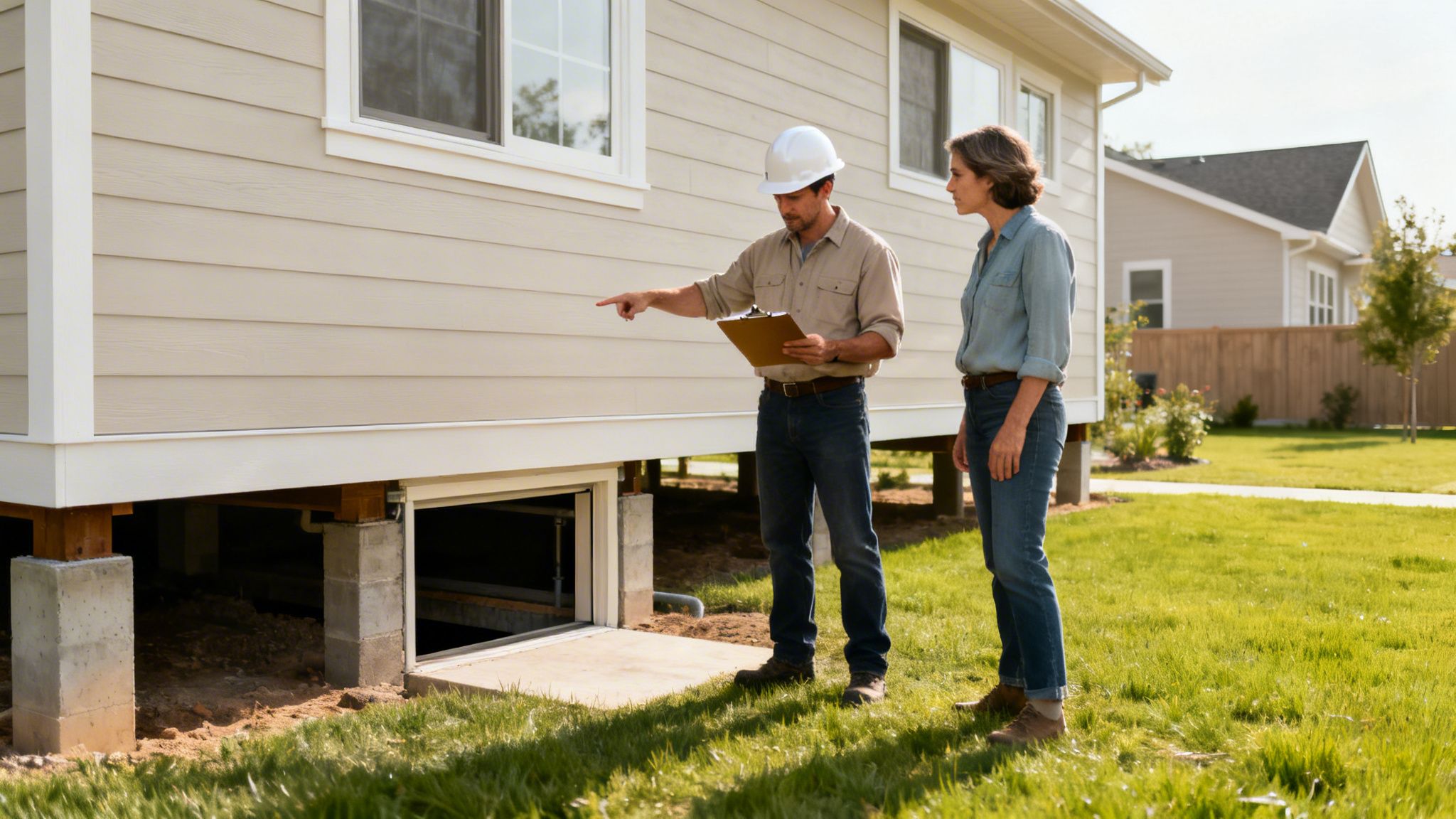
The success of your pier and beam foundation repair comes down to one thing: the skill and integrity of the team you hire. This isn’t just another weekend project—it’s a major structural investment in your property’s safety and long-term value.
Finding the right contractor here in the Dallas-Fort Worth area means finding a partner who genuinely understands our wild clay soils and has a long history of getting the job done right. It can feel like a lot to sort through, but with the right checklist, you can find a company that’s skilled, honest, and ready to stand behind their work.
Your Contractor Vetting Checklist
Before you even think about signing a contract, run every potential company through this list. A reputable contractor won’t just have this information available; they’ll be proud to share it.
Here’s what you absolutely need to verify:
- Proper Licensing and Insurance: This is the bare minimum. Make sure they have both general liability and worker’s compensation insurance. If they don’t, any accident on your property could become your financial nightmare. No exceptions.
- Deep Local Experience: North Texas soil is a world of its own. You need a team that has spent years—better yet, decades—working on DFW homes. A national company with a generic playbook just won’t cut it here.
- Transparent Evaluations: A good contractor gives you a detailed, written report that explains the why behind the problem, the how of the repair plan, and a clear cost breakdown. They should welcome your questions, not dodge them with pressure tactics.
- Strong, Transferable Warranties: Quality work is always backed by a solid structural warranty. The key here is to ask if it’s transferable. A warranty that can be passed on to the next homeowner is a huge selling point if you ever decide to move.
Key Questions to Ask During a Consultation
The initial meeting is your chance to interview them. Don’t hold back—their answers tell you everything you need to know about their professionalism and expertise.
Have these questions ready:
- How long have you been repairing pier and beam foundations specifically in the DFW Metroplex?
- Can you give me the contact information for a few recent local customers?
- Who is my main point of contact during the project, and how will you keep me updated?
- What specific materials are you planning to use for the piers, shims, and beams? Why those?
- What’s your plan for protecting my yard, plants, and the rest of my property while you work?
The most important question you can ask is simple: “Why is this the best fix for my house?” A great contractor will walk you through the root cause of the failure and connect it directly to their proposed solution. You should walk away feeling confident you’re getting a permanent fix, not a temporary patch-up job.
When you start comparing bids, look past the final number. A shockingly low quote is almost always a red flag. It could mean they’re using cheap materials, hiring an uninsured crew, or—worst of all—planning an incomplete repair that will just fail again in a few years. An honest quote reflects the real cost of quality materials and skilled labor. When it comes to your home’s foundation, cutting corners is never worth the risk.
Common Questions About Pier and Beam Repair
When you’re dealing with foundation issues, questions are bound to pop up. As a homeowner, the last thing you want is uncertainty. We’ve been doing this for a long time in the Dallas-Fort Worth area, and we’ve put together answers to the questions we hear most often to help you get a handle on the process.
How Long Does Pier and Beam Foundation Repair Take?
This is a tough one to answer without seeing your home, as the timeline really depends on the scale of the job. There’s no magic number, but I can give you a general idea.
A simple reshimming job, where we’re just tightening things up, might take a day or two. But if we’re talking about something more involved—like replacing rotted beams, pouring new piers, and leveling a big section of your house—that could easily stretch to a week or more.
A few things really dictate the schedule:
- The Size of Your Home: A bigger footprint simply means more ground to cover.
- Crawl Space Access: If there’s plenty of room to work (think 18 to 36 inches of clearance), our crew can move efficiently. A cramped, tight crawl space will naturally slow things down.
- The Repair Method Itself: Adjusting existing piers is much faster than excavating and installing brand new ones.
Any professional contractor worth their salt will give you a clear, detailed schedule before they start. You’ll know exactly what to expect and when, so you can plan around the work.
Will My Homeowners Insurance Cover Foundation Damage?
This is the big question for most people, and the answer isn’t always straightforward. In most cases, standard homeowners insurance policies do not cover foundation damage caused by gradual soil settlement. And since the shifting clay soil here in North Texas is the main culprit, that means most issues aren’t covered.
However, there are some important exceptions. Your policy might kick in if the damage was the direct result of a sudden, specific event—what the insurance world calls a “covered peril.”
Think of it this way: gradual soil movement over years is seen as a maintenance issue, which isn’t covered. But a sudden event that causes immediate damage often is. A classic example is a plumbing line bursting under your slab; if that leak washes away soil and causes your foundation to sink, your policy might very well cover the repair.
Other events that could trigger coverage include:
- Damage from a fire or explosion.
- Direct damage from a tornado or other major storm.
- Vandalism that compromises the home’s structure.
The best advice I can give is to read your policy carefully and talk to your agent. If the damage does seem to stem from a covered event, a reputable foundation company can provide the professional engineering reports you’ll need to support your claim.
Can We Stay in the House During the Repair Work?
Absolutely. In almost every pier and beam repair scenario, you can stay right where you are. This is actually one of the big perks of this type of foundation. All the work happens in the crawl space, so the disruption to your daily life is minimal.
You’ll hear some noise while the crew is working underneath the house, that’s unavoidable. But a professional team knows how to be respectful of your space and will keep their work area as tidy as possible.
If the project is a major one, like a full-house leveling, your contractor will let you know if there are specific times when it might be best to be out. But having to pack up and move out completely is extremely rare.
How Can I Prevent Future Foundation Problems?
Being proactive is the best way to protect your foundation. Here in DFW, it all comes down to one thing: water management. Controlling the moisture in the soil around your home is the single most important thing you can do.
Here are the most effective steps you can take:
- Maintain Your Gutters: Keep them clear of leaves and gunk so they can do their job.
- Extend Your Downspouts: Make sure they carry water at least 5-10 feet away from the foundation.
- Check Your Grading: The ground should slope away from your house, not towards it. You don’t want water pooling against your foundation.
- Water Your Foundation: During our blistering Texas summers, use a soaker hose to keep the soil moisture consistent. This prevents the soil from shrinking and cracking.
- Ventilate Your Crawl Space: Good airflow is key to stopping moisture buildup, which leads to wood rot and attracts termites.
Finally, getting a professional inspection every few years is a smart move. It helps you catch small problems before they become big, expensive headaches. A little prevention truly goes a long way.
If you’ve spotted any of these warning signs or just have a question about your home’s foundation, don’t wait for it to get worse. The experts at Black Beard Foundation Repair offer free, no-obligation evaluations for homeowners all over the Dallas-Fort Worth area. Protect your biggest investment and schedule your inspection today at https://blackbeardfoundationrepair.com.


