
That little crack in your drywall? The bedroom door that suddenly refuses to close properly? It’s easy to write these off as minor quirks of an aging house, but for homeowners in Allen, they can be the first whispers of a much bigger problem: foundation distress.
Learning to spot these early clues is the single most important thing you can do to protect your home’s value and, more importantly, its structural safety.
What Are the Warning Signs of Foundation Problems
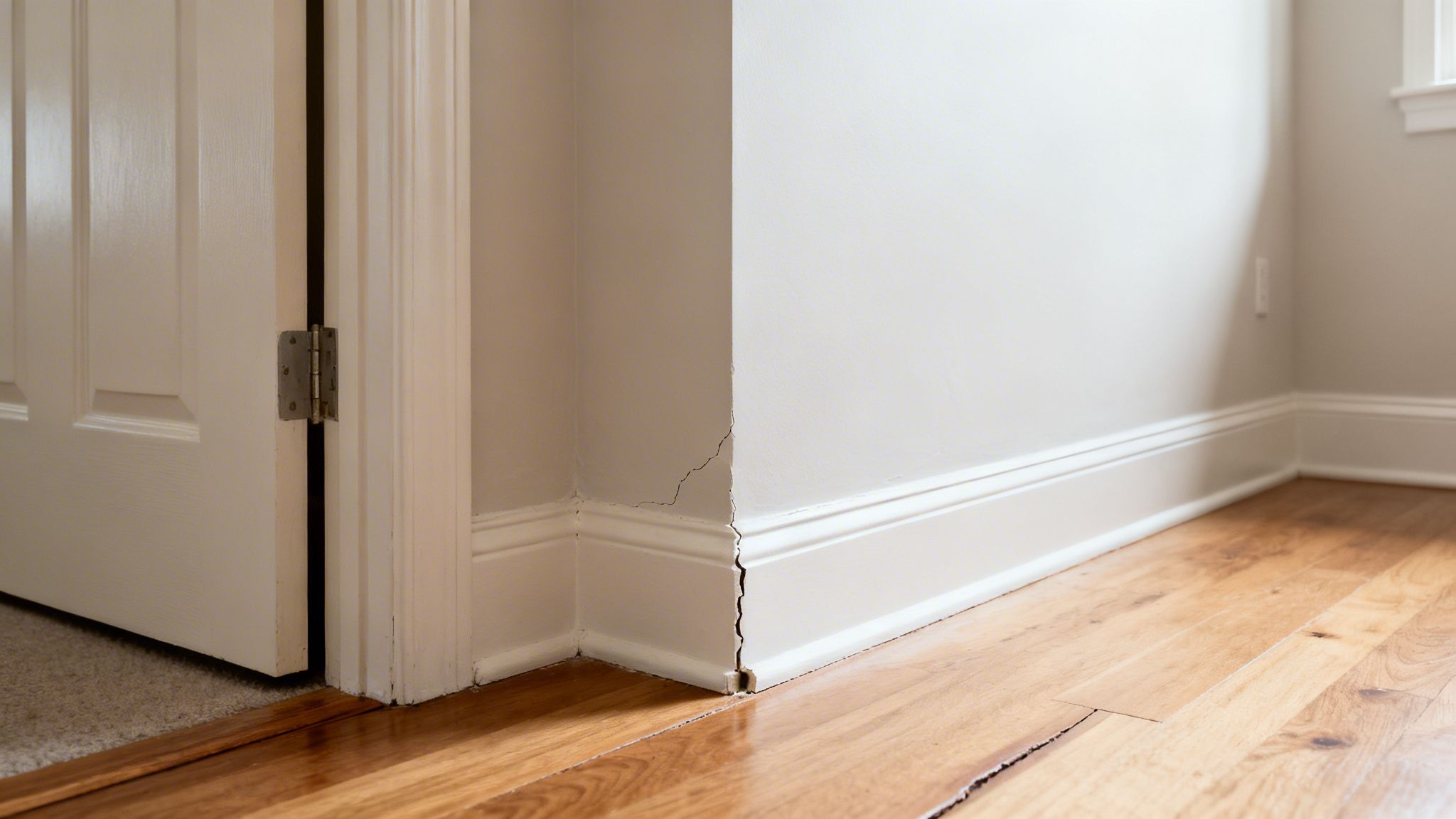
Your house has a way of telling you when something is wrong. The signs can be subtle at first, but they are almost always there if you know what to look for. Ignoring them is a gamble, as small issues can quickly snowball into major, expensive repairs. Think of it as a quiet alarm system—your job is to recognize the alert before it becomes a full-blown emergency.
And you’re not alone in this. Foundation problems are becoming increasingly common. The repair industry was valued at a staggering USD 11.8 billion in 2025 and is expected to climb to USD 20 billion by 2035. That’s a growth rate of 5.4% every year, which just goes to show how many homeowners are dealing with these exact same issues.
Key Interior Warning Signs
Inside your home is where you’ll likely notice the first hints of trouble. Keep an eye out for these telltale signs:
- Cracks in Walls and Ceilings: Zig-zagging or diagonal cracks over doorways, windows, or where the wall meets the ceiling are classic red flags. While tiny hairline cracks can be from simple paint settling, anything larger is a cause for concern.
- Sticking Doors and Windows: Is a door suddenly jamming in its frame? Do your windows fight you every time you try to open or close them? This often means the frames have been warped by the foundation shifting beneath them.
- Uneven or Sloping Floors: If you drop a marble and it consistently rolls to one side of the room, you’re looking at a sloping floor. You might also feel bouncy or soft spots underfoot, which is a clear sign of settling.
- Gaps Around Trim and Baseboards: Take a look at your crown molding and baseboards. Are they pulling away from the wall, leaving a noticeable gap? That’s a signal that the walls are moving as the foundation settles unevenly.
Telltale Exterior Red Flags
A quick walk around the outside of your house can often provide the most damning evidence. Here’s what you should be looking for.
“The most obvious exterior sign is stair-step cracking in brick or masonry. These jagged, diagonal cracks follow the mortar lines and are a direct result of one part of the foundation sinking lower than another.”
You should also look for a chimney that’s tilting or pulling away from the house. Another big one is gaps forming around your garage door frame, making it look crooked.
To help you get started, here’s a quick rundown of what to look for both inside and out.
Quick Checklist for Foundation Warning Signs
| Location | Sign to Look For | What It Might Mean |
|---|---|---|
| Interior | Cracks in drywall, especially over doors/windows | The house frame is under stress from foundation movement. |
| Interior | Doors and windows that stick or don’t latch | The frames are being twisted out of square by settlement. |
| Interior | Sloping or uneven floors | A portion of your foundation has likely sunk. |
| Exterior | Stair-step cracks in brick or masonry | Uneven settling is causing the wall to fracture. |
| Exterior | Chimney tilting or pulling away from the house | The soil supporting the chimney is failing or shifting. |
| Exterior | Gaps around the garage door or window frames | The foundation under that section is moving. |
Each of these symptoms points toward an underlying instability that needs a professional eye. For a deeper dive, our foundation inspection checklist for DFW homes is a great resource. Catching these warnings early is the best way to ensure a timely and effective foundation repair Allen solution.
Why North Texas Soil Is So Tough On Your Home’s Foundation
Ever feel like foundation problems are just a part of living in Allen and North Texas? You’re not wrong, but it’s not because of bad luck or shoddy construction. The real issue is right under our feet: the infamous expansive clay soil that defines our region.
Think of this soil less like solid ground and more like a powerful, unpredictable sponge.
When it’s dry, it’s hard and shrunken. But when the rains come, it soaks up incredible amounts of water and swells up, pushing everything above it with immense force. This is exactly what’s happening to your foundation. During a wet spring, the clay soil under your home expands, lifting and stressing the concrete slab.
Then comes our brutal Texas summer. The sun bakes all that moisture right back out, and the soil shrinks, cracks, and pulls away from your foundation. This relentless cycle of swelling and shrinking, year after year, is what causes most of the foundation damage we see around here.
The Ground Beneath You Is Never Still
This constant movement is terrible news for a heavy, rigid structure like your house. The soil rarely moves evenly. Maybe one side of your house gets more runoff from the sprinklers, or a shady spot holds moisture longer. This causes one part of the foundation to be pushed upward while another part might be sinking into dry, shrunken soil.
This “differential movement” is the direct cause of those tell-tale signs like wall cracks, doors that won’t close properly, and sloping floors. It’s a slow-motion tug-of-war between the dynamic earth and your static home.
It’s hard to overstate the power we’re talking about. A single cubic foot of saturated clay soil can exert over 10,000 pounds of pressure per square foot. That’s more than enough force to lift a concrete slab and the entire house on top of it.
With forces like that at play, even the most well-built homes in Allen are at risk. It’s not a question of if the soil will move, but how much and where. Knowing this is the first step to understanding why professional foundation repair in Allen is so essential.
Other Culprits Working Against Your Foundation
While our clay soil is the main villain, a few other local factors can make a bad situation much worse.
- Big, Thirsty Trees: We love our mature oaks and elms, but their massive root systems are incredibly thirsty. In the summer, a large tree can pull 50 to 150 gallons of water from the soil every single day. If that tree is close to your house, its roots can suck the ground dry under one corner of your foundation, causing that area to sink dramatically.
- Bad Drainage: Where water goes matters. Clogged gutters, downspouts dumping right next to the house, or landscaping that slopes toward your home all create problems. Water pools against the foundation, super-saturating the soil in one spot. This leads to extreme swelling and throws the pressure under your home completely out of balance.
- Hidden Plumbing Leaks: An under-slab plumbing leak is one of the most destructive issues we see. Even a slow drip constantly feeds moisture into one area, causing the clay there to stay permanently swollen. This creates a “heave” that pushes that part of your foundation upward while other parts are settling, resulting in severe stress on your home’s structure.
These factors rarely act alone; they team up with our challenging soil to cause real damage. Foundation problems here aren’t a sign you’ve done something wrong—they’re an environmental reality. Understanding these forces is key to knowing when it’s time to call in the experts to protect your investment.
So, What Are My Repair Options?
Once you’ve spotted the warning signs of foundation trouble, the next big question is, “Okay, how do we fix this?” The good news is that modern foundation repair techniques are incredibly effective, specifically designed to tackle the unique soil challenges we face here in North Texas. These aren’t just temporary patches; they’re permanent engineering solutions meant to secure your home for the long haul.
The goal isn’t simply to jack your house back into place. It’s about fundamentally changing how your home is supported. We want to transfer the massive weight of your house off that unstable, shifting clay soil and anchor it to a much deeper, more solid layer of earth that doesn’t swell or shrink with the weather. This is why professional foundation repair in Allen is so critical for homeowners.
This diagram really breaks down the forces constantly battering your foundation.
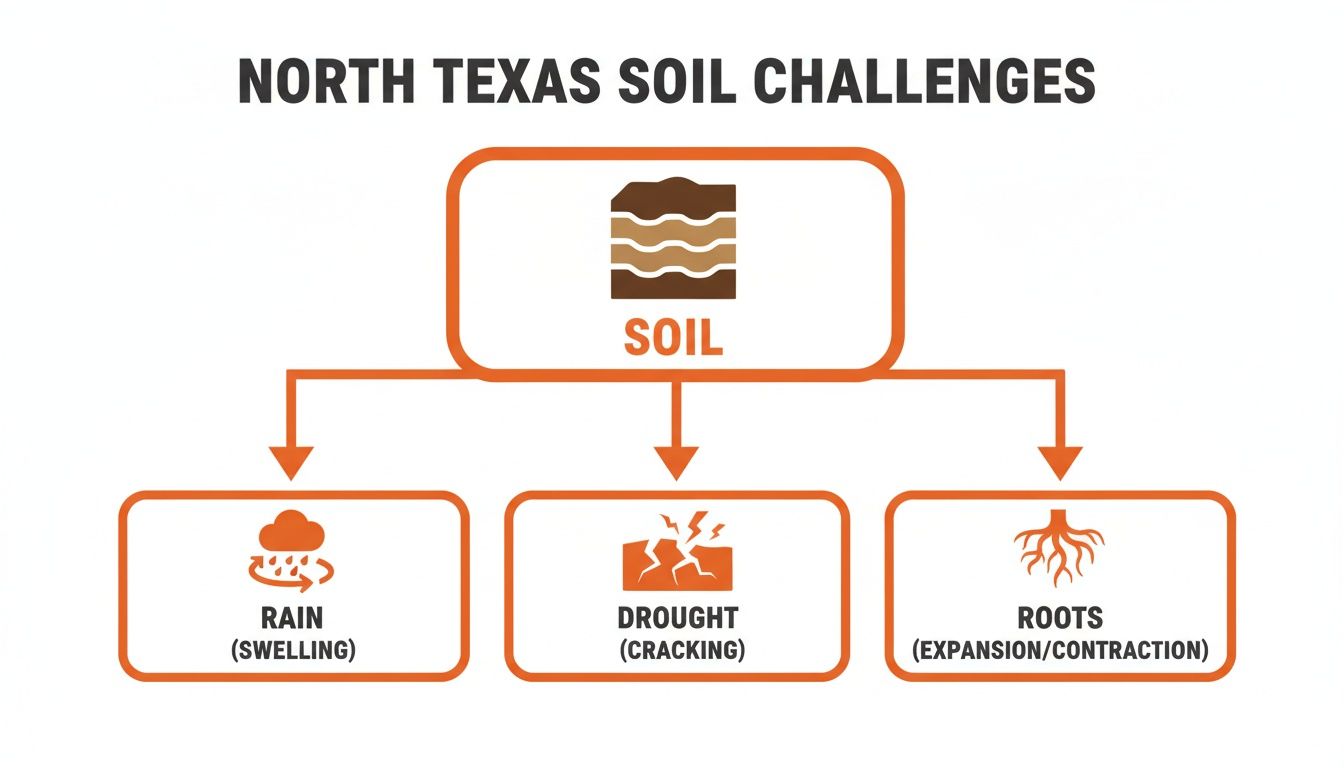
As you can see, that constant cycle of heavy rain, intense drought, and thirsty tree roots creates a volatile environment right under your feet.
Pressed Concrete Piers: The Go-To Solution
For most slab foundations, pressed concrete piers are the workhorse of the industry. Think of them as a series of powerful, underground stilts that we install to hold up your home. Our crews strategically dig small access points around the edge of your foundation. Then, using hydraulic power, we press pre-cast concrete cylinders deep into the ground.
We keep driving these sections, one on top of the other, until we hit what’s called the “point of refusal”—a layer of soil or rock so dense it won’t budge. That’s how we know it can reliably support your home. Once all the piers are installed, we use a synchronized hydraulic lifting system to gently raise the settled areas of the foundation, which often fixes those sticky doors and ugly wall cracks right then and there.
Steel Piers for Unmatched Stability
Sometimes, a situation calls for even more muscle. That’s where steel piers come in. These are heavy-duty steel pipes driven even deeper into the ground, often reaching depths of 25 to 70 feet or more to anchor directly into solid bedrock.
Steel piers provide the ultimate level of stability, making them the perfect solution for heavier homes or properties sitting on especially difficult soil. While they cost a bit more upfront, the long-term security and peace of mind they offer are incredible.
Think of piers as a permanent bypass for the problem soil. Instead of letting your house ride the waves of that expansive clay, you’re anchoring it to solid ground far below the ‘active zone’ where all that movement happens.
Under-Slab Tunneling: The No-Mess Approach
What happens if the problem isn’t just your foundation settling, but a plumbing leak somewhere under the middle of your living room floor? In the old days, the only answer was a jackhammer. Crews had to smash through your concrete slab, destroying your flooring and creating a huge mess inside your home.
Thankfully, there’s a much smarter way now: under-slab tunneling.
Our team digs a small tunnel from the outside of your home, working our way underneath the foundation to the exact spot where the leak is. This gives plumbers direct access to make the repairs without ever stepping foot inside your house.
- No Interior Mess: Your floors, furniture, and daily routine are completely undisturbed.
- Saves Money: It often prevents the massive expense of replacing floors and repairing interior damage.
- Clean and Contained: All the digging and dirt stay outside where they belong.
This technique is a true game-changer for fixing under-slab plumbing issues, which are a common cause of foundation heave in the Allen area. If you’ve suddenly noticed a crack in your floor slab, a hidden leak could easily be the culprit, and tunneling is the clean, efficient way to fix it.
Pier and Beam Foundation Restoration
Older homes with pier and beam foundations have their own unique set of issues, usually tied to moisture and age. Repairing them is a different ballgame and often involves:
- Replacing Damaged Wood: We swap out any rotted or termite-damaged sill plates, floor joists, or support posts.
- Re-Shimming and Leveling: We adjust the small wedges (shims) that sit between the piers and the beams to level out sagging floors.
- Crawl Space Encapsulation: By installing a heavy-duty vapor barrier, we can control moisture and prevent future wood rot, mold, and pest problems.
The need for these kinds of specialized repairs is a big deal. In fact, North America dominates the global foundation services market, holding about 45% of the $3.0 billion industry projected for 2026. This is largely driven by our region’s aging homes and challenging soil, making professional maintenance a must.
Budgeting for Your Foundation Repair Project
When you first notice signs of foundation trouble, two big questions pop into your head: “How much is this going to cost?” and “How long will my house be a construction zone?” Getting straight answers is key to your peace of mind, not to mention your wallet.
While every home is different, we can pull back the curtain on the numbers and timelines you can generally expect for a professional foundation repair Allen project.
Think of it this way: foundation repair isn’t a one-price-fits-all service. Just like a doctor can’t quote a price for surgery without a diagnosis, we can’t give you a number without a thorough evaluation. A minor lift on one corner of your garage is a completely different ballgame than stabilizing your entire home with dozens of piers.
That’s why a detailed, on-site inspection is a non-negotiable first step. Only after an expert has taken elevation readings, walked the property, and understood the unique soil conditions at your home can any reputable company give you an accurate quote.
Key Factors That Influence Your Final Cost
Several things directly impact the final price tag. Your estimate is a detailed calculation based on exactly what your home’s foundation needs to be stable and secure again. Knowing what goes into it helps you understand what you’re paying for.
- Number and Type of Piers: This is the biggest driver of cost. The more support your home needs, the more piers we’ll have to install. Steel piers typically cost more than concrete ones due to the material itself and the deeper installation required, but they offer unmatched strength.
- Extent of the Damage: Are we just fixing a small, settled area, or has the whole house shifted? Widespread movement requires a much more comprehensive—and therefore more expensive—solution.
- Accessibility: If our crew has to work around elaborate landscaping, a prized rose garden, or a big concrete patio, it adds time and labor to the job. The same goes for installing piers inside your home versus outside.
- Need for Under-Slab Tunneling: If your plumbing has been damaged by the shifting slab, we’ll need to tunnel underneath to fix it. While it’s an added expense, tunneling is almost always a better and cheaper option than jackhammering through your living room floor.
This isn’t just a challenge we face here in North Texas. The foundation repair industry is growing worldwide as infrastructure ages and homeowners continue to battle difficult soil. One market analysis projects the industry to grow from USD 3.30 billion in 2024 to USD 6.20 billion by 2032. You can read more about the economic trends of this industry on the HTF Market Report website.
Understanding the Project Timeline
Just like the cost, the time it takes to complete your repair is tailored to the job. We get it—having a work crew at your home is a disruption. Our goal is always to work as efficiently and cleanly as possible to get your life back to normal.
A professional foundation repair team’s primary objective is to provide a permanent solution with minimal intrusion. Timelines are carefully planned to ensure every step, from excavation to final cleanup, is executed methodically and safely.
A typical project has a few distinct phases that add up to the total time on-site.
- Prep and Digging: First, we prepare the site, protect your plants and landscaping as much as possible, and dig the holes where each pier will be installed. This usually takes a day or two.
- Pier Installation and Lifting: This is the main event. Driving each pier to the point of refusal is a careful, precise process. Once all the piers are in, we gently and evenly lift the foundation back toward its original position.
- Backfilling and Cleanup: With the lift complete, we fill in all the holes, tamp down the soil, and clean up the entire work area. We aim to leave your property looking neat and tidy.
For a relatively small job needing 5-10 piers, the whole thing might be done in just 1-3 days. A bigger, more complex project with 20 or more piers could take a week or longer. No matter the scope, we’ll give you a clear and realistic timeline before we start, so you know exactly what to expect from day one.
How to Choose the Right Foundation Repair Company in Allen

Picking the right contractor is easily the most critical decision you’ll make when dealing with a foundation problem. The quality of the repair, how long it lasts, and your own peace of mind are all on the line. With so much riding on this choice, you need to know how to spot a true professional and avoid the risks.
Making a smart decision goes way beyond just grabbing the lowest bid. It’s about finding a team with the right local experience, proper credentials, and solid customer protections. Let’s walk through how to do just that.
Vet Their Local Experience and Expertise
North Texas soil is a unique beast. A generic, one-size-fits-all approach to foundation repair just won’t cut it here. The very first thing to check is a company’s hands-on experience working specifically in Allen and the surrounding DFW metroplex. A contractor who truly understands our expansive clay soil and the wild weather cycles that affect it will design a much more effective, long-term solution.
Don’t be shy—ask them directly about their work in your neighborhood. A seasoned local company will already know the common soil types and issues in your area, giving them a huge head start in correctly diagnosing and fixing the real source of your problem.
Verify All Credentials: Insurance and Licensing
This part is absolutely crucial and protects you from some serious financial and legal headaches. Before you even think about signing a contract, you have to confirm the company is fully licensed, bonded, and insured.
- General Liability Insurance: This is what covers any accidental damage to your property while they’re working. If they hit a water line or crack your driveway, their insurance pays for it, not you.
- Workers’ Compensation Insurance: This one is a deal-breaker. It protects you from being sued if a worker gets injured on your property. Without it, you could be on the hook for their medical bills and lost wages.
Don’t just take their word for it. Ask to see the actual insurance certificates and check that they’re up-to-date. Any reputable company will hand them over without a second thought.
Insist on a Lifetime Transferable Warranty
A company’s warranty tells you everything you need to know about how much they stand behind their own work. For an investment of this size, you should settle for nothing less than a lifetime transferable warranty. Think of it as your long-term security blanket, guaranteeing the job for the entire life of your home.
A “transferable” warranty is a huge plus. It means the guarantee is tied to the house itself, not just to you. If you ever sell, this becomes a major selling point for buyers, giving them confidence that the foundation is solid.
Make sure you read the fine print. You need to know exactly what the warranty covers (it’s usually the specific piers they installed) and if there’s anything that could void it down the road. This single piece of paper can add thousands to your home’s resale value.
Gather Multiple, Detailed Estimates
Never, ever go with the first quote you get. It’s smart to get at least two or three detailed, written estimates from different qualified companies. This isn’t just about comparing prices; it’s about comparing their proposed solutions and watching out for red flags.
Each estimate should give you a clear diagram of your foundation, showing where they plan to put the piers, what type of piers they’ll use, and a complete cost breakdown. Vague contracts or pushy sales tactics are big warning signs. A true expert will provide a clear, easy-to-understand plan and give you the time to make your own decision. By carefully comparing these proposals, you can make a confident, informed choice for your foundation repair Allen project.
At Black Beard Foundation Repair, we’re proud to serve our community. You can learn more about our commitment to providing top-tier foundation repair services in Allen, TX.
Got Questions? We’ve Got Answers.
Even with a good grasp of the signs and solutions, you probably still have some very practical questions about what a foundation repair project actually entails. These are the real-world concerns that pop up when you’re thinking about your home and daily life in Allen. Getting straight answers can make the whole idea a lot less intimidating.
Let’s walk through some of the most common questions we hear from homeowners. Our goal is to clear things up so you know exactly what to expect—before, during, and after the job.
Will the Repair Crew Wreck My Yard?
This is, without a doubt, one of the first things people ask. It’s completely understandable. You’ve put time and effort into your lawn and garden beds, and the thought of them getting torn up is stressful. A true professional shares that concern and makes protecting your property a top priority.
A good crew has a system to keep things tidy. They should lay down heavy-duty tarps or sheets of plywood to protect your grass from the excavated dirt and equipment. If a prized rose bush or shrub is sitting right where they need to dig, they’ll carefully remove it, set it aside, and replant it for you when they’re done.
The holes themselves are dug strategically and aren’t as massive as you might think—usually about three feet by three feet. It’s just enough space to get the work done right. The whole point is to fix your foundation for good while leaving your landscaping looking as if we were never there.
Does Homeowners Insurance Cover Foundation Damage?
This is a big one, and unfortunately, the answer for most folks in Texas is a bit complicated. Your standard homeowners policy (HO-3) almost always has an exclusion for damage caused by soil movement—settling, shifting, or the expansion and contraction of our infamous clay soil. Since that’s the primary cause of foundation issues here in Allen, coverage is rare.
But there are a few important exceptions. If the foundation problem was a direct result of another issue that is covered by your policy, you might have a case.
Think of it this way: a pipe suddenly bursts under your slab. That leak soaks the ground, causing the soil to heave and crack your foundation. The damage wasn’t from normal soil movement; it was from a specific, covered event—the plumbing failure. That’s a situation where you may have a valid claim.
A reputable repair company can provide the detailed engineering reports and causation analysis your insurance adjuster will need. This documentation is crucial for showing that the damage qualifies for coverage under your policy.
How Do I Keep This From Happening Again?
Once your home is back on solid ground, the last thing you want is a repeat performance. The good news is that preventing future problems is all about proactive, simple maintenance.
The number one goal is to keep the soil moisture consistent all the way around your house. This stops those destructive cycles of soil swelling when it’s wet and shrinking when it’s dry.
- Start a Smart Watering Routine: During those long, hot Texas summers, lay a soaker hose about 18-24 inches away from your foundation. Run it just enough to keep the soil lightly damp, not muddy or saturated.
- Master Your Drainage: Keep those gutters clean. Add extenders to your downspouts so they direct rainwater at least 5-10 feet away from the house. You never want water pooling up against the slab.
- Mind Your Trees: Big, thirsty trees close to the house can be a problem. Their roots will suck every last drop of moisture from under your foundation. A simple underground root barrier can stop them in their tracks.
Making these small things a habit can make a huge difference in protecting your foundation and your investment.
What’s the Real Deal with a “Lifetime Transferable Warranty”?
A lifetime transferable warranty is more than just a nice-sounding phrase; it’s a serious guarantee that the work is built to last. It’s important to know what it actually means.
Essentially, the warranty covers the specific piers that were installed. If any of those piers settle or fail down the road, allowing that part of your foundation to move again, the company will come back and adjust them at no cost to you.
The “transferable” part adds major value. It means the warranty is tied to the property, not to you personally. When you eventually sell your Allen home, that warranty passes to the new owners. For a potential buyer, having that documented proof of a secure foundation is a massive confidence booster and a powerful selling point.
Ready to get a clear, honest assessment of your home’s foundation? The expert team at Black Beard Foundation Repair provides free, no-obligation evaluations to homeowners across Allen and the DFW area. Contact us today to schedule your inspection.


