
Foundation water damage isn’t just about a little water getting in. It’s what that moisture does to the ground underneath your home that causes the real trouble. When the soil gets saturated, it swells, and when it dries out, it shrinks. This constant movement puts enormous stress on your concrete foundation, eventually leading to cracks, uneven settling, and serious structural problems.
This is a particularly big deal for us here in North Texas, thanks to our infamous expansive clay soil.
Why Dallas Foundations Are Uniquely at Risk
If you’re a homeowner in the Dallas-Fort Worth area, you’re not just living on dirt; you’re living on a powerful, ever-changing force of nature. The ground beneath our feet is mostly expansive clay, which acts a lot less like stable earth and more like a giant sponge. This one simple fact is why foundation water damage is such a massive issue for DFW homes.
During our notorious downpours, this clay soil soaks up incredible amounts of water, swelling and pushing against your foundation with unrelenting force. Then, when our equally famous summer heat and dry spells hit, the soil loses that moisture, shrinks, and pulls away from the concrete, leaving it completely unsupported.
This endless cycle of swelling and shrinking creates a brutal push-pull effect on your home’s foundation. Think about bending a paperclip back and forth—eventually, the metal fatigues and snaps. The same principle applies to your foundation, leading to a much higher risk of movement, settling, and failure than you’d find in other parts of the country.
Primary Threats to DFW Foundations
Here’s a quick look at the most common sources of water that can compromise North Texas foundations.
| Water Source | Impact on Clay Soil and Foundation |
|---|---|
| Poor Drainage & Grading | Rainwater pools against the foundation, creating hot spots of intense soil saturation and pressure. |
| Plumbing Leaks | A slow, hidden leak under the slab can oversaturate the clay, causing it to heave upward and crack the concrete. |
| High Groundwater Table | Persistent moisture from below keeps the soil constantly expanded, leading to upheaval and long-term instability. |
| Overzealous Irrigation | Sprinklers set too close to the home continuously dump water where it’s not needed, mimicking poor drainage. |
| Aggressive Tree Roots | Large tree roots can drink up all the moisture from under a foundation, causing the soil to shrink and settle unevenly. |
Knowing what you’re up against is the first step in protecting your home. These sources turn a natural soil condition into a direct threat to your property’s stability.
It’s no surprise that the United States has the world’s largest market for foundation repair services, valued at a whopping USD 667.8 million. A huge chunk of that comes from regions like North Texas, where our soil is constantly putting up a fight. That market is only expected to grow as homeowners look for lasting solutions to protect their investments.
Your home’s foundation is only as stable as the ground it rests on. In Dallas-Fort Worth, that ground is constantly in motion, making proactive water management non-negotiable for long-term structural health.
Staying vigilant is key. You can start by doing regular walk-arounds of your property. For a more structured way to keep an eye on things, our foundation inspection checklist for DFW homes can guide you on what to look for season after season.
How to Spot Early Signs of Foundation Water Damage
Catching foundation water damage early can mean the difference between a straightforward fix and a massive structural problem. Your house is always giving you little clues about its health; you just have to know how to read them. These issues usually start small, but they’re direct signals that excess water is making the ground shift beneath your home.
Think about your house as one big, connected frame. When water soaks into our Texas clay soil, one part of the foundation might sink or heave, and that tiny movement torques the entire structure. Suddenly, that door that won’t close properly isn’t just an annoyance—it’s a sign that the whole frame is being pulled out of square.
Putting on your detective hat and learning to spot these clues can save you a world of trouble and thousands of dollars down the road.
Interior Warning Signs to Watch For
Often, the very first signs of a foundation issue pop up right inside your living space. You walk past these walls, doors, and floors every single day, so they’re the first place you’ll notice something’s off.
Here are the most common things to look out for inside:
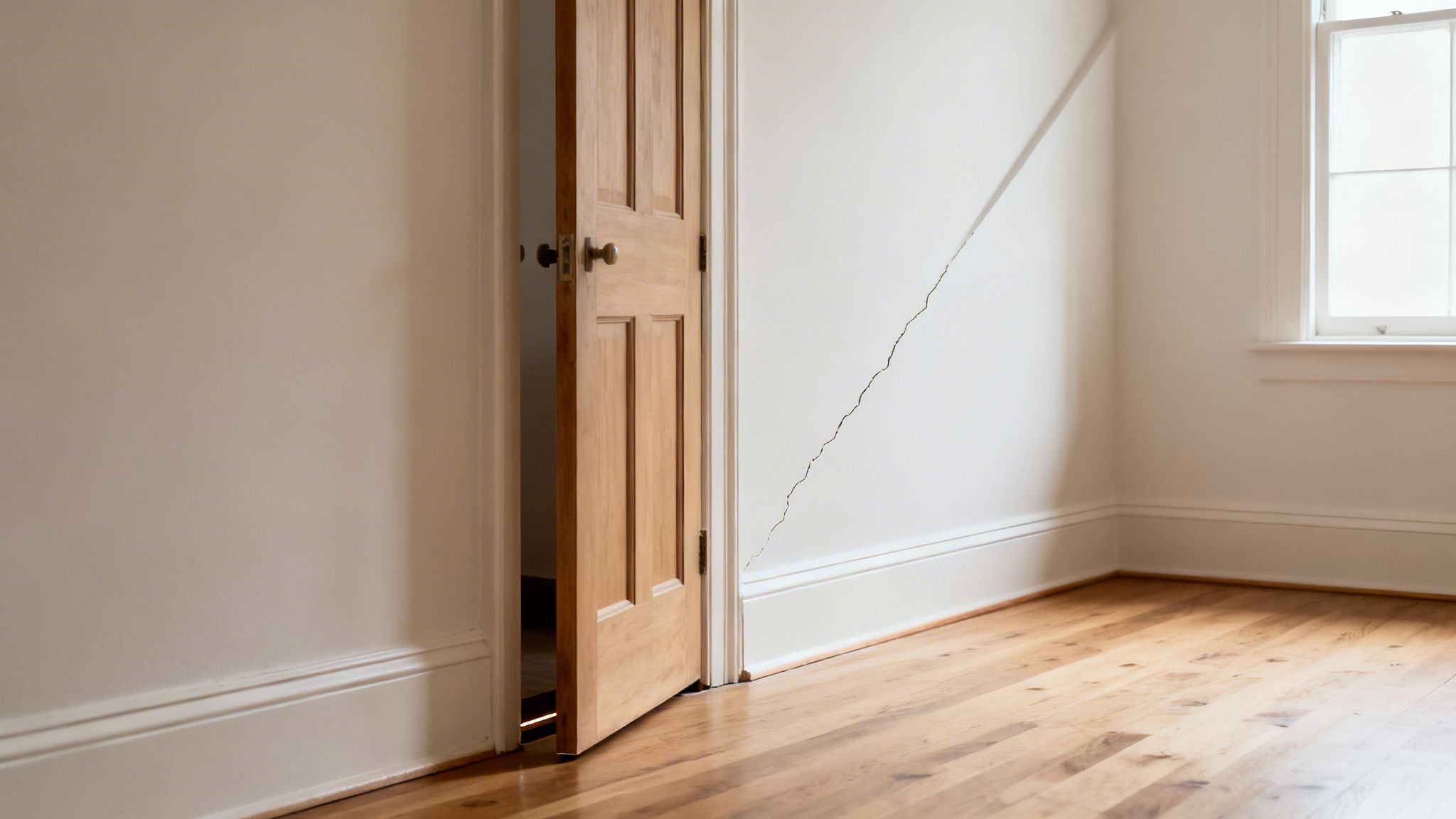
- Cracks in Drywall or Plaster: Pay special attention to cracks spidering out from the corners of doors and windows. These are classic stress fractures from a foundation on the move.
- Doors and Windows That Stick: If a door that used to swing freely now jams in its frame, or a window is a real struggle to open, the frame has likely shifted.
- Sloping or Uneven Floors: A floor that feels bouncy, soft, or has a noticeable slope is a major red flag. If you drop a marble, does it roll to one side of the room on its own? That’s a bad sign.
- Gaps Between Walls and Ceilings: Look for separation where your walls meet the ceiling or the floor. These gaps mean the structure is literally being pulled apart by underlying pressure.
These symptoms are your home’s early warning system. Getting to know the difference between various cracks can tell you a lot. For a closer look, you can learn more about how to read the story told by foundation cracks and settling in our detailed guide.
Exterior Red Flags You Cannot Ignore
While the interior signs are easy to spot during your daily routine, a quick walk around the outside of your house can reveal even more direct proof of water-related foundation damage. This is where you can see the foundation itself starting to fail.
A stable foundation needs stable soil. When water gets into the ground around your home, it pushes the foundation around, and the evidence of that fight will always show up on your home’s exterior.
Keep an eye out for these critical signs on the outside of your property:
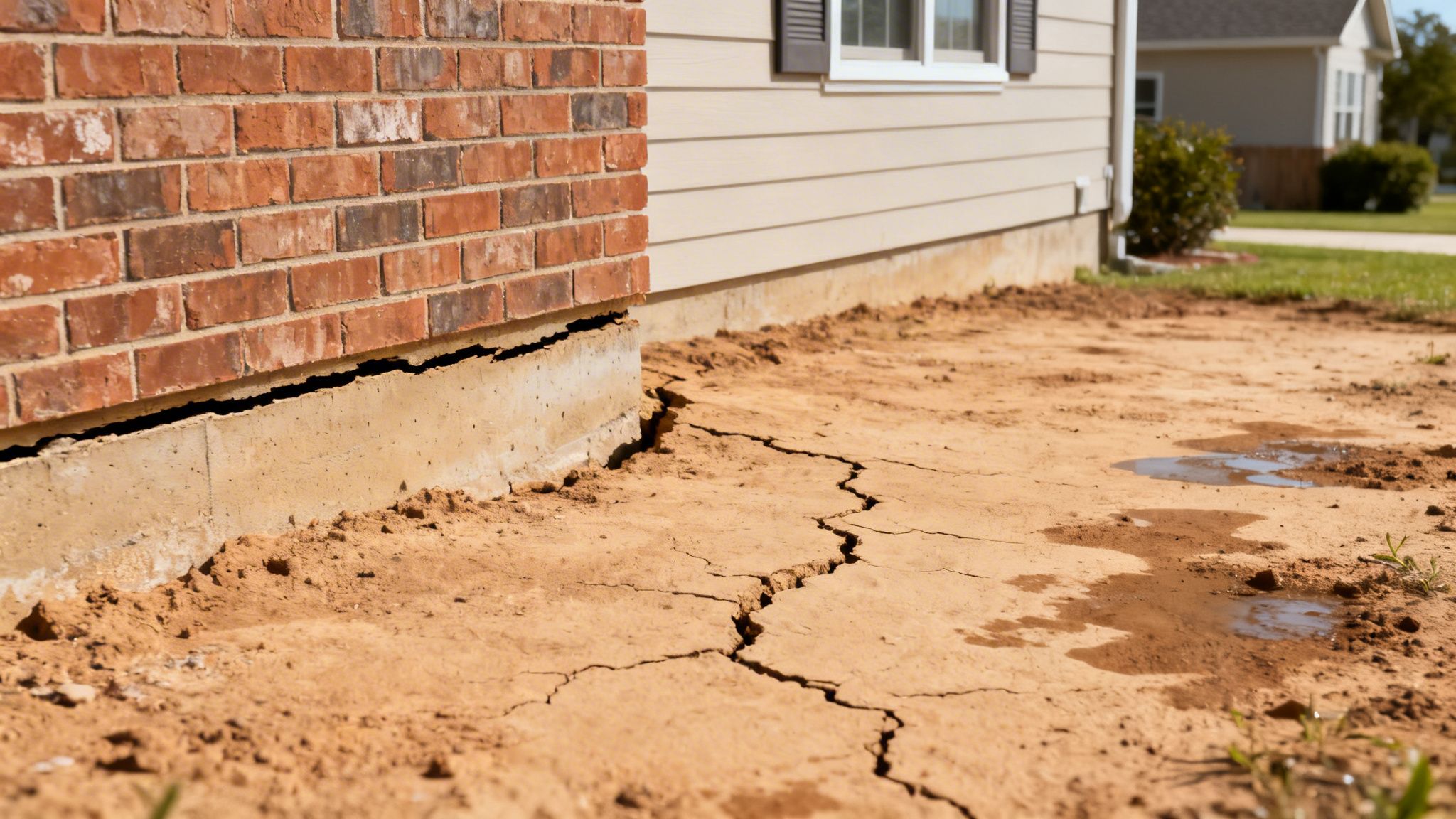
- Cracks in the Brick or Masonry: Those zigzagging, stair-step cracks in brick walls are the textbook sign of a foundation settling unevenly.
- Gaps Around Window Frames or Doors: If you see new, noticeable gaps between your brick siding and the frames of your windows or garage door, it’s a clear indication of serious shifting.
- A Leaning or Tilting Chimney: A chimney pulling away from the house is a severe symptom. This isn’t something to watch; it’s something that needs immediate, professional attention.
- Visible Foundation Cracks: Don’t dismiss cracks in the exposed concrete slab. Horizontal cracks are especially alarming because they often point to intense hydrostatic pressure from water-logged soil.
Seeing even one of these signs means it’s time to take action. Catching it early is your strongest defense against the destructive power of water. A professional evaluation can get to the root of the problem and stop it from spiraling, protecting your home and your peace of mind.
The Real Culprits Behind Foundation Water Damage
Spotting a crack in the wall or a door that suddenly starts to stick is easy. The hard part is figuring out why it’s happening. Foundation problems don’t just pop up overnight; they’re the result of water getting into places it shouldn’t be, which throws the sensitive clay soil under your home completely out of whack.
Think of it like this: your foundation is carefully balanced on the soil beneath it. When water soaks one area and leaves another dry, that balance is gone. The ground heaves, sinks, and shifts, and your foundation is caught in the middle. Finding the source of that water is the absolute key to a permanent fix. Just patching a crack without stopping the water is like bailing out a boat with a hole in it—you’re just buying a little time before it sinks.
Let’s dig into the five most common reasons water starts wreaking havoc on a home’s foundation. Knowing these will help you understand what’s really threatening your home.
Poor Surface Drainage and Bad Grading
Honestly, the most frequent cause of foundation trouble is also the simplest: rainwater with nowhere to go. During one of those classic Texas downpours, your yard should be channeling all that water away from your house. When it doesn’t, your foundation becomes the first line of defense, and it wasn’t built for that.
This usually comes down to two main issues:
- Improper Grading: The ground right up against your house needs to slope away from the walls. It doesn’t have to be dramatic, but it needs to be consistent. If your yard is flat or, worse, slopes back towards the house, every rainstorm turns the edge of your foundation into a small pond.
- Faulty Gutters: Your gutters and downspouts are your home’s water management MVPs. But if they’re clogged with leaves or the downspouts just dump water right next to the foundation, you’re concentrating a massive amount of water in one small spot.
This creates pockets of super-saturated soil that swell up like a sponge, pushing with incredible force against one part of your foundation while other areas stay dry. This uneven pressure is what starts the cracking and settling.
Under-Slab Plumbing Leaks
While you can see the rain, some of the worst damage happens completely out of sight. A tiny leak in a water or sewer line running beneath your concrete slab can drip for months or even years before anyone notices. It’s a slow, steady release of water directly into the soil that supports your home.
This constant moisture turns stable clay into a soupy, unstable mess. The soil swells and pushes the slab upward from below, often creating a “hump” or “dome” in the middle of your house. The first clues might be a surprise jump in your water bill or finding a random warm spot on your floor.
Don’t underestimate these hidden leaks. Globally, water damage from plumbing failures causes an estimated $1.2 billion in losses every year. It’s the second most common homeowners insurance claim, happening five times more often than theft and a staggering seven times more often than fire. You can learn more about these insurance implications and see just how common this hidden issue is.
High Groundwater and Saturated Soil
Sometimes, the threat isn’t coming from the sky but from deep underground. The water table—the natural level where the ground is completely saturated—can rise dramatically after long stretches of heavy rain. Here in North Texas, a rising water table can push up against the bottom of your slab with tremendous force, creating what we call hydrostatic pressure.
Hydrostatic pressure is just a technical term for the force that standing water exerts. When the soil under and around your foundation is full of water, that water pushes on the concrete from all sides, looking for any tiny crack or weak spot to get through.
This constant upward pressure can actually lift the whole slab or cause water to seep right through the concrete, making your home feel damp and further wrecking the soil’s stability.
Aggressive Tree Roots
We all love our big, beautiful trees, but underground, their roots can be relentless. During our hot, dry summers, tree roots go on a mission to find moisture, and the soil under your foundation is often the best source around.
As a big tree’s roots suck gallons of water out from under one corner of your house, the clay soil there shrinks and compacts. This causes that part of your foundation to sink and settle, creating the same kind of damaging, uneven movement as overly wet soil. The result is often a web of cracks and floors that are noticeably sloped.
Expansive Clay Soil and Our Wild Weather
At the end of the day, the very ground our DFW homes are built on is part of the problem. Expansive clay soil is in a constant state of motion—it swells dramatically when it’s wet and shrinks when it’s dry. The typical North Texas weather cycle of torrential spring rains followed by blazing hot, bone-dry summers creates a perfect storm for foundation failure.
Each of the issues we’ve talked about feeds into this dangerous cycle, turning the ground under your home from a stable base into an active threat. Figuring out which one—or which combination—is affecting your property is the first step toward a real, lasting solution.
So, What Are Your Professional Repair Options?
Seeing signs of foundation water damage can be stressful, and it’s easy to feel overwhelmed. But here’s the good news: modern foundation repair isn’t about tearing your house apart. It’s about smart, engineered solutions that bring your home’s stability back for good. The first step is always a professional evaluation to move you from worrying to having a clear plan.
Unlike a simple patch-up job that just covers a crack, real foundation repair gets to the root of the problem—the unstable, water-logged soil under your home. The whole point is to bypass that shifting clay and anchor your foundation to solid, stable ground deep below. This isn’t a temporary fix; it’s a permanent solution.
The right method for your home will depend on a few things: your foundation type, how severe the damage is, and what’s causing the water problem in the first place. This is why an expert diagnosis is so critical—it allows for a custom-tailored repair strategy.
This decision tree gives you a simple look at how a pro might trace the problem back to its source.
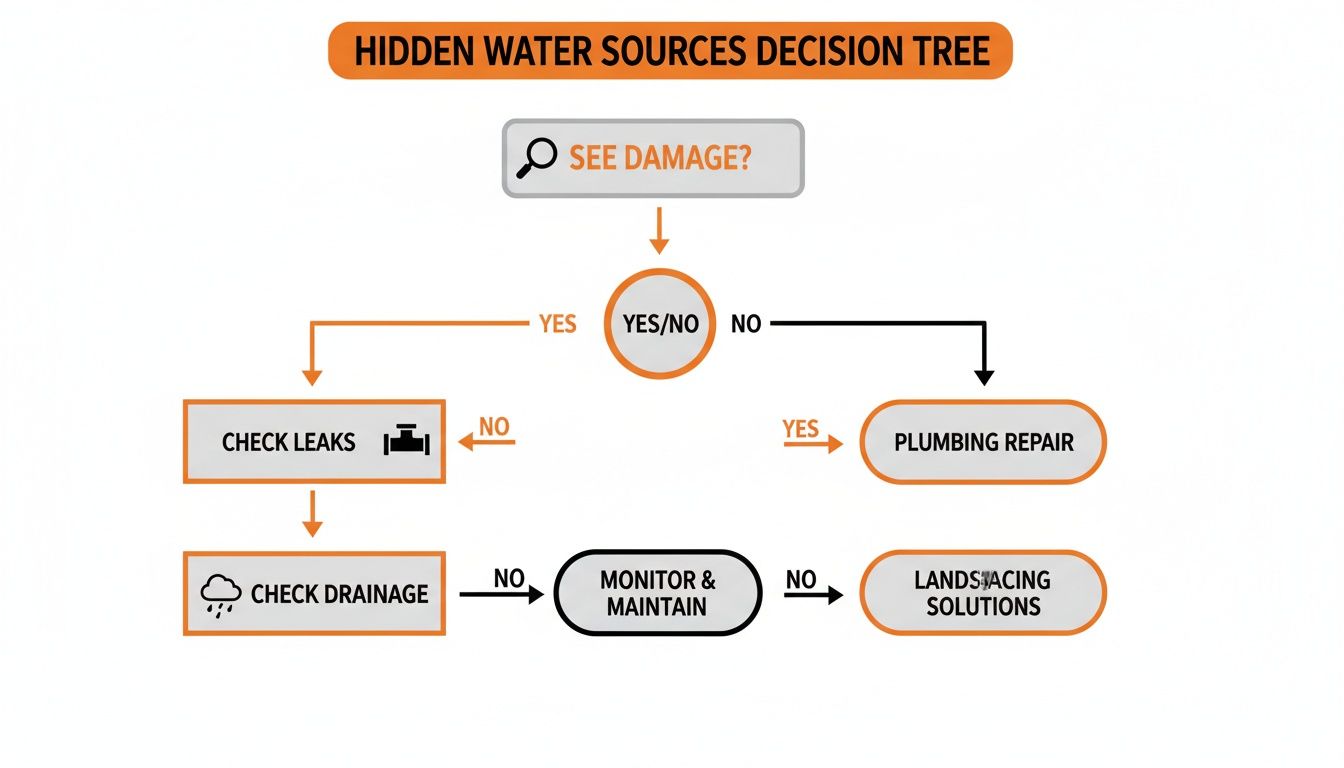
As you can see, it all starts with noticing the damage. From there, it’s a process of elimination to figure out if it’s a plumbing leak, bad drainage, or something else, which ultimately points to the right repair.
Steel Piers: The Ultimate Support System
When your home is settling because the soil is shrinking or completely waterlogged, steel piers are the go-to solution. Think of them as stilts for your foundation. They transfer the entire weight of your house off the unstable clay and onto solid bedrock or a strong layer of soil far beneath the surface.
The process is surprisingly methodical and designed to cause as little disruption as possible:
- First, we excavate small, strategic holes around the outside of your foundation.
- Next, we use hydraulic power to drive high-strength steel pipes deep into the ground until they hit what we call “refusal”—a solid layer that won’t budge.
- Then, powerful hydraulic jacks carefully and evenly lift the foundation back toward its original level. It’s a slow, controlled process.
- Once everything is level, the piers are locked into place and permanently secured to your foundation, giving it unwavering support.
This approach essentially makes your home independent from the moody topsoil, putting an end to problems caused by our expansive Texas clay.
Under-Slab Tunneling: The No-Mess Interior Fix
What if the problem is a leaky pipe right under the middle of your house? Years ago, the only answer was to bring in a jackhammer and destroy your floors. It was a dusty, disruptive nightmare. Thankfully, today we have under-slab tunneling.
Instead of coming through your living room, our crews dig a small tunnel from the outside of your home, working their way directly underneath the concrete slab to the exact spot of the leak. This gives plumbers room to make repairs and allows our team to install interior piers, all without a single boot stepping on your floors.
Under-slab tunneling is a game-changer. It preserves your flooring, keeps dust and debris outside, and lets you live comfortably in your home while we work. It’s a surgical approach to what used to be a very messy problem.
This technique is a perfect example of how the best methods focus on both getting the job done right and respecting your home.
Other Fixes for Slabs and Pier-and-Beam Homes
Not every foundation issue needs deep-driven steel piers. Depending on what we find during our evaluation, other proven methods might be a better fit.
- Slab Stabilization: If your concrete slab has heaved upward or cracked from expanding soil, we can often use polyurethane foam injection. We inject a specialized foam beneath the slab, which expands to fill empty pockets, compact loose soil, and gently lift the concrete back where it belongs.
- Pier-and-Beam Restoration: Older homes with crawl spaces have their own unique needs. Repairs often involve reskimming (adding a new layer of concrete) or replacing failing piers, adding new support posts, or replacing wooden beams and joists that have rotted from moisture.
At the end of the day, the only way to know for sure which solution is right for your home is with a professional assessment. The experts at Black Beard Foundation Repair can pinpoint the exact cause of your foundation water damage and lay out a clear repair plan to restore your home’s safety and your peace of mind.
Navigating Repair Costs and Insurance Coverage
Once a pro confirms water is damaging your foundation, two big questions pop up immediately: “How much is this going to set me back?” and “Will insurance cover any of this?” Getting straight answers is key to making a smart plan without the stress.
The truth is, repair costs can swing wildly, and whether your insurance policy helps out often boils down to one thing: where the water came from.
What Goes into the Final Price Tag?
The final bill for fixing your foundation really depends on how bad the damage is and which repair method we need to use. A relatively minor fix using slab stabilization might be a few thousand dollars. On the other hand, a major project that requires a whole crew to install steel piers and lift a large section of your home will naturally be a bigger investment.
Several things can affect the total cost:
- How many piers are needed? The more support points required to make your home solid again, the higher the cost.
- How deep do we have to go? We drive piers down to stable bedrock. Deeper bedrock means more materials, time, and labor.
- Can we get to the problem area easily? Sometimes we can work from the outside, but other times, under-slab tunneling is the best bet. It’s less messy for you but can be more complex for us.
- What’s the scope of the issue? Fixing one sinking corner is a completely different ballgame than leveling an entire side of the house.
Because every single home is different, the only way to get a real number is with a thorough, on-site evaluation.
The Hard Truth About Homeowners Insurance and Foundations
This is where things often get tricky. Most standard homeowners insurance policies are built around a core idea: they cover damage that is sudden and accidental, not damage that happens slowly over time. That distinction is everything when it comes to foundation water damage.
Here’s a simple way to think about it. If a pipe explodes under your slab and the sudden gush of water causes the ground to shift and your foundation to heave, your policy will likely step in. That’s a clear, one-time event. But if the damage is from years of poor drainage letting water seep into the soil, insurance companies usually see that as a maintenance issue and won’t cover it.
Most insurance carriers expect homeowners to keep up with routine maintenance—like ensuring good drainage and clean gutters—to prevent gradual problems from developing in the first place.
This is why it pays to know what’s actually in your policy. Take flooding, for example. It’s a huge threat to foundations, but it’s almost never covered by a standard homeowners policy. Globally, floods are a massive problem, causing average annual losses of around USD 388 billion. And those numbers are climbing. You can discover more about the growing global risk of floods to see just how serious it is.
How to Handle a Potential Insurance Claim
If you have a strong reason to believe the damage was caused by something sudden, like a plumbing leak you just discovered, your first call should be to a foundation specialist. An expert diagnosis from a team like ours at Black Beard provides the professional evidence you need to even begin the claims process.
Working with someone who knows the ropes can make all the difference. We provide the detailed reports and documentation your insurance adjuster will need to make a fair decision. For a deeper dive, check out our guide on navigating foundation repair insurance claims. Going in prepared is always your best move.
Protecting Your Home Starts Now
We’ve covered a lot of ground in this guide, exploring how Dallas-Fort Worth’s notorious expansive clay soil and wild weather swings can really do a number on your foundation. From poor drainage and hidden plumbing leaks to the subtle warning signs like cracked bricks and doors that just won’t close right, it’s clear that water is the number one enemy of a stable home.
Ignoring these clues is a gamble. Small problems don’t fix themselves; they fester and grow, eventually leading to bigger, more expensive structural headaches down the road. If there’s one thing to take away from all this, it’s that being proactive is your single best defense. Catching a problem early is the most powerful tool you have to protect your home’s stability and value.
The best first step? Get a professional to take a look. A no-obligation evaluation moves you out of the guessing game and into a place of clarity, giving you a straightforward plan based on facts, not fear.
What to Expect During Your Free Evaluation
A true professional inspection isn’t about a hard sell. It’s a fact-finding mission to diagnose the health of your foundation and give you honest answers.
Here’s what our certified specialists do:
- A Full Walk-Through: We’ll perform a thorough visual check of your home, inside and out, looking for all the classic signs of foundation stress and water damage.
- Precise Elevation Readings: Using specialized equipment, we’ll take elevation measurements across the entire slab. This gives us a precise map showing exactly where and by how much your foundation has shifted.
- A Clear Conversation: We’ll walk you through our findings in plain English, show you what we see, explain what’s causing it, and answer every single one of your questions.
Your home is your biggest investment. An expert evaluation is the most effective way to understand its structural health and stop small problems from becoming major crises.
Don’t let a small crack turn into a major repair bill. Schedule your free, no-obligation foundation evaluation with Black Beard Foundation Repair today. Let our team give you the clarity and peace of mind you deserve.
Got Questions About Your Foundation? We’ve Got Answers.
When you start noticing signs of foundation trouble, a million questions probably pop into your head. That’s completely normal. Getting clear answers is the first step to feeling in control again. Here are a few of the most common things we hear from homeowners in our area.
How Long Will the Repairs Take?
This is usually the first thing people ask, and the honest answer is: it depends. A simple, straightforward job, like securing one corner of your home, might only take our crew a day or two.
On the other hand, if we’re looking at a more complex fix—say, installing a full set of steel piers all the way around your house—that could take a week or more. We also have to factor in things like how easy it is to get to the foundation, what the soil is like, and of course, the ever-unpredictable Texas weather. No matter what, we’ll always give you a solid timeline before we ever start the work.
Will My Homeowners Insurance Cover This?
This is a big one, and the answer almost always comes down to why the damage happened. Generally, homeowners insurance covers problems that are sudden and accidental. Think of a pipe suddenly bursting under your slab—that’s the kind of event your policy is designed for.
The key thing to remember is that insurance is for unexpected disasters, not for problems that develop slowly over time. Damage from ongoing issues like poor drainage or gradual soil settlement is almost never covered by a standard policy.
For those situations, you’d typically need a separate flood insurance policy. Your best bet is to pull out your policy documents and see exactly what’s covered.
Can I Sell My House if It’s Had Foundation Work?
Yes, you absolutely can. In fact, having the work done right can actually make your home more appealing to buyers. When a professional company like ours completes the repairs and provides a transferable lifetime warranty, it’s a huge plus.
Think about it from a buyer’s perspective. They get documented proof that a known problem has been permanently solved. It shows you’ve taken care of the home and gives them total peace of mind, which can be a much better selling point than a house with a questionable foundation history.
Don’t let foundation worries keep you up at night. The team at Black Beard Foundation Repair is here to give you straight answers with a free, no-pressure evaluation. Schedule your free inspection with us today!


