
When you’re dealing with foundation trouble, the solution isn’t one-size-fits-all. It’s about getting to the root of the problem—whether it’s our notorious North Texas soil shifting or water getting where it shouldn’t—and applying a specific, professional fix. That could mean installing steel piers, mudjacking a sunken slab, or shoring up an old pier-and-beam system.
The most important thing for any homeowner here is learning to spot the first signs of trouble, like a crack that wasn’t there last month or a door that suddenly refuses to latch. Catching it early and calling an expert is how you stop a small issue from becoming a major headache.
Spotting the Early Warning Signs of Foundation Issues
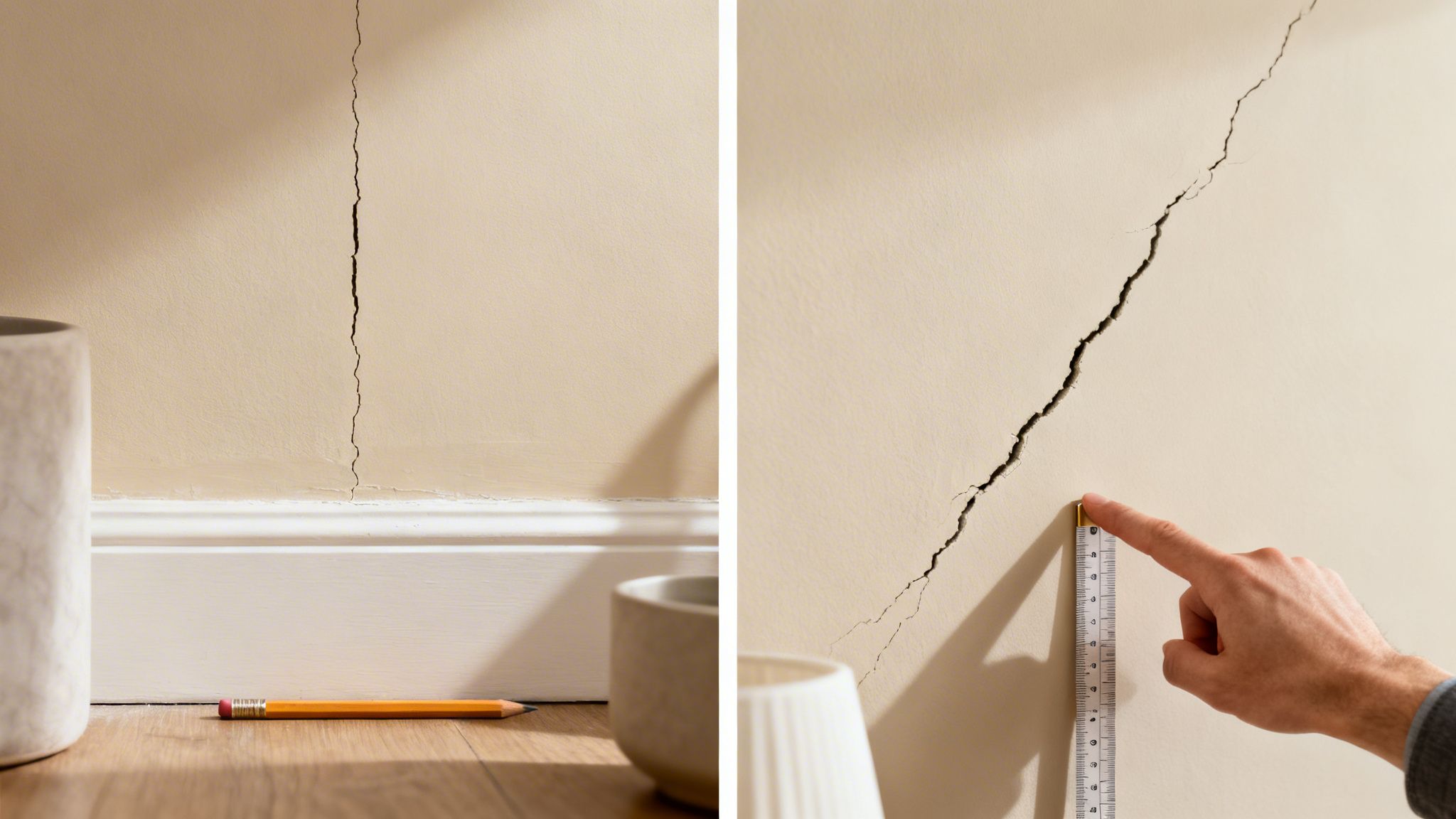
That tiny, hairline crack in your drywall might just be paint settling. Then again, it could be the first whisper of a much bigger conversation your house is trying to have with you. Here in North Texas, with our expansive clay soil constantly on the move, ignoring these subtle hints is one of the biggest gambles a homeowner can take.
Learning to read these signs is the first real step toward fixing a foundation problem before it spirals into a massive, expensive project. Think of yourself as a detective for your own home. Your job is to gather the clues and figure out what’s just normal wear-and-tear and what’s a genuine distress signal.
Cracks Are More Than Just Cracks
Not all cracks are created equal. The location, direction, and size of a crack tell a story about the forces pushing and pulling on your home. Sure, a vertical crack that perfectly follows a drywall seam is often just the house settling normally. But certain patterns are definite red flags.
- Diagonal Cracks: If you see a crack running at a 45-degree angle out from the corners of your doors and windows, pay attention. This is a classic sign of differential settlement, meaning one part of your foundation is sinking faster than another.
- Stair-Step Cracks: Look at your exterior brickwork. Those zig-zag cracks that follow the mortar lines are a textbook symptom of foundation movement. You’ll often spot them starting near a corner of homes in places like Plano or Fort Worth, where soil movement is a constant battle.
- Horizontal Cracks: These are the ones that demand immediate attention, especially in a basement wall. A horizontal crack signals immense pressure from the soil outside, which can cause the wall to bow and, in worst-case scenarios, fail completely.
A lot of people think any small crack is fine. The truth is, the pattern and location are way more important than the initial size. A diagonal crack over a doorframe is a much more urgent warning than a long, thin vertical crack in the middle of a wall.
Doors, Windows, and Floors Don’t Lie
Your foundation is the bedrock of your entire home. When it moves, even a fraction of an inch, it creates a ripple effect that shows up in very predictable ways.
Is a door suddenly sticking in its frame? Does a window feel impossible to open or close? That’s not just an annoyance; it’s a symptom. The frame is likely being twisted out of square by a shifting foundation. Take a look at the gaps around a closed door—if it’s wider at the top and tight at the bottom, that’s a tell-tale sign of uneven settling.
Your floors are another great source of clues. Do you feel a soft, bouncy spot in your pier-and-beam house? Or notice a distinct slope in one of your rooms? Here’s a simple trick: place a marble or golf ball on the floor. If it consistently rolls to the same spot, you’ve got a slope that needs a closer look. You can get a better handle on what these symptoms mean by reading up on the links between foundation cracks and settling.
By doing a regular walk-through of your property with these signs in mind, you can shift from just worrying about a problem to actively identifying it. That’s the first—and most critical—step in protecting your home’s value and your family’s safety.
A Homeowner’s Guide to a DIY Foundation Inspection
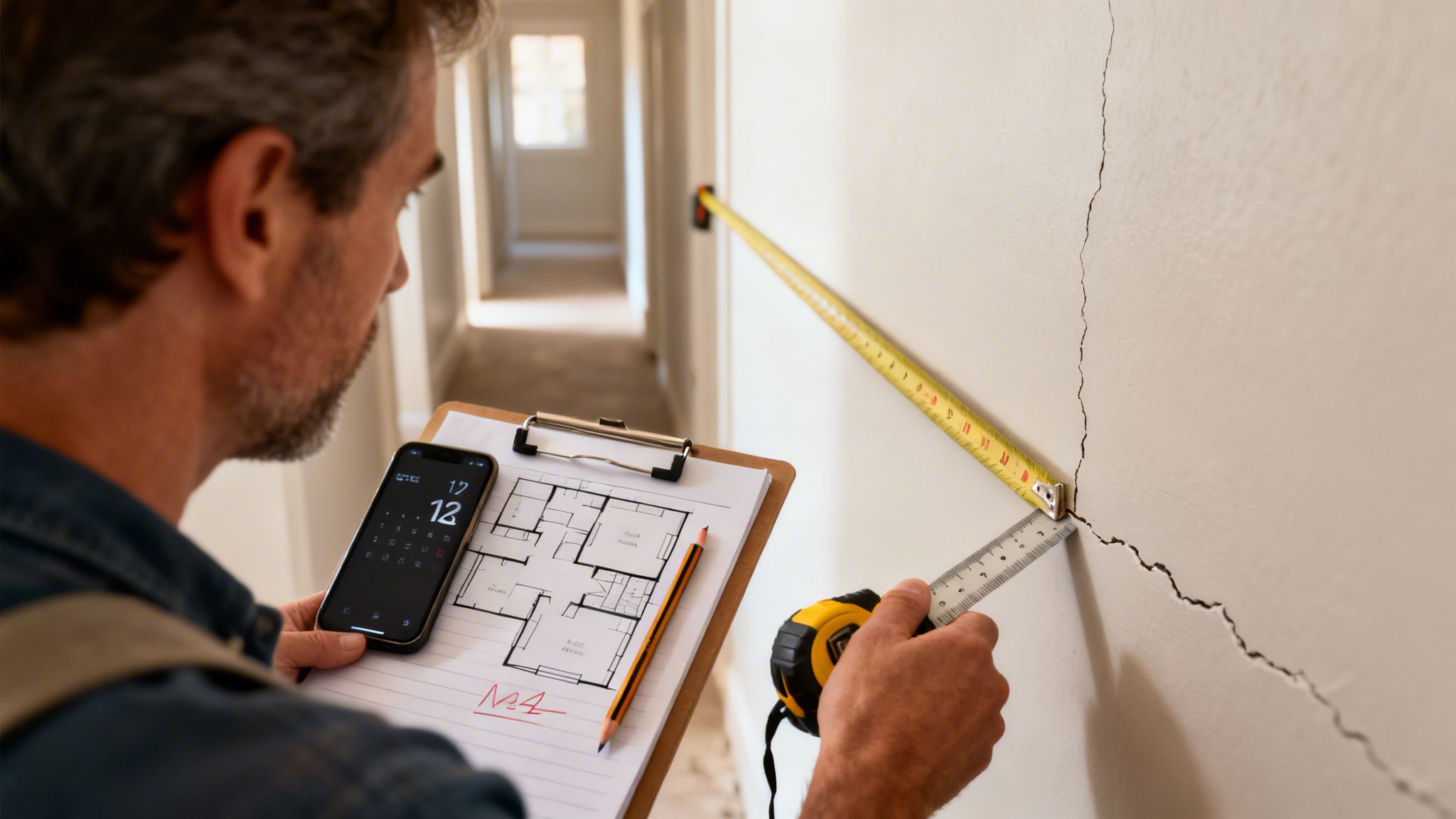
So, you’re seeing some signs that make you nervous. That’s the first step. But turning that gut feeling into real, useful information is what comes next. Before you can even think about repairs, you have to get a handle on what’s actually happening to your home.
This isn’t about being an engineer. It’s about being a detective. With a few simple tools and a methodical eye, you can create a baseline—a snapshot in time—that will be incredibly valuable, whether you’re just monitoring the situation or bringing in a professional.
Start By Mapping the Cracks
Your most important tools right now are a tape measure, a pencil, and a notebook. We’re going to create a “crack map” that documents every weak point you can find, inside and out.
Pick a room and start there. Go corner to corner, floor to ceiling. When you spot a crack in the drywall, tile, or even the slab itself, stop and document it.
- Note the length: Measure it from one end to the other.
- Check the width: Find the widest part of the crack and jot down that number.
- Mark it: This is the key part. Put a small, light pencil mark at each end of the crack and write down today’s date. Now you have a reference point to see if it’s getting bigger.
Doing this gives you a factual history of your home’s movement. A tiny crack that suddenly widens over a few months is a much bigger red flag than a crack that hasn’t changed in five years. For a more structured approach, you can dive deeper into what to look for with a detailed foundation inspection checklist for DFW homes.
Test Your Doors, Windows, and Exterior Gaps
Cracks are only part of the story. How your house functions tells you a lot about the stress it’s under. A shifting foundation will often twist and warp the frames of doors and windows, making them difficult to operate.
Walk through every room and test every single door and window. Do they stick? Do you have to shove your shoulder into a door to get it to latch? Do the deadbolts line up easily, or do you have to jiggle the knob and lift the door to get it to lock? These are classic signs of a frame being torqued out of square.
Don’t stop inside. A quick walk around the perimeter of your home can reveal a lot. Look closely at the line where your foundation meets the dirt. Do you see a gap where the soil has pulled away from the concrete? This is a huge clue, especially in North Texas, that the clay soil is shrinking from dryness, which often leads to settlement.
Finally, keep an eye out for plumbing problems. A mysterious damp spot on your carpet, a water bill that shoots up for no reason, or the sound of running water when everything is turned off could signal an under-slab leak. This is serious, as leaking water can wash away the soil supporting your foundation, creating a void that leads to major problems.
Why North Texas Clay Soil Is Your Foundation’s Biggest Challenge
If you want to get to the bottom of foundation problems, you first have to understand what’s causing them in the first place. Here in North Texas, the real culprit isn’t your house or how it was built—it’s the ground it’s sitting on. We have notoriously expansive clay soil all across the Dallas-Fort Worth area, and it’s the number one reason so many of us see those unsettling cracks and shifts in our homes.
Think of the ground under your house as a giant, slow-moving sponge. That’s a pretty good picture of how our regional clay behaves. It’s not a stable, solid material; it’s constantly changing its size and shape based on the weather.
The Destructive Shrink-Swell Cycle
This endless movement is what we call the “shrink-swell” cycle, and it’s driven by our wild Texas weather. We go from long, punishing droughts to sudden, heavy downpours, keeping the moisture in the soil in constant flux. That puts an incredible amount of stress on your foundation.
Here’s a look at how this natural process plays out for your home:
- During a Drought: When the summer sun beats down for weeks, it sucks all the moisture right out of the clay. As the soil particles dry out, they shrink, and the ground literally contracts and pulls away from your foundation. That loss of support is what causes parts of your home to sink or settle, creating those classic diagonal cracks you see above doorways.
- After Heavy Rain: Then, when the inevitable Texas thunderstorms roll in, that parched clay soaks up water like it’s dying of thirst. As it absorbs all that moisture, it expands with tremendous force. This upward pressure, known as “heaving,” can actually lift sections of your foundation, making floors uneven and causing doors to stick tight in their frames.
This constant back-and-forth of sinking and heaving creates a battle between your rigid concrete foundation and the volatile earth it rests on. Over years of this, the stress leads to cracks, breaks, and the kind of serious structural problems that demand a professional fix.
A Widespread and Costly Problem
This isn’t just a minor headache; it’s a huge architectural challenge for our entire region. The numbers really show how common and expensive this problem is for homeowners around here.
In fact, expansive clay soils are linked to foundation issues in up to 60% of homes built before 2000 in the DFW area. If left unchecked, this kind of damage can easily slash a property’s value by 10-20%. This regional issue is a major reason why the U.S. foundation repair market is the world’s largest, hitting USD 667.8 million in 2024. You can explore more data on the foundation repair market to see just how big this is.
The key takeaway is simple: your foundation isn’t failing because it’s weak. It’s under attack from powerful, natural forces. Understanding this is crucial because the right repair isn’t just about patching a crack; it’s about building a permanent defense against this relentless shrink-swell cycle.
Knowing the soil is the enemy makes it clear why preventative maintenance, like proper drainage and consistent foundation watering, is so important. It also explains why professional solutions like steel piers aren’t just designed to lift your house back up, but to anchor it deep below this volatile clay, giving it the long-term stability it needs to survive in North Texas.
Exploring Professional Foundation Repair Solutions
Once you’ve confirmed the foundation movement is more than just the house settling, it’s time to look beyond DIY checks and explore professional solutions. Figuring out how to fix foundation problems isn’t about finding a single “best” method; it’s about matching the right technique to the specific issue your home is facing. The real goal isn’t just to patch a crack. It’s to stabilize your home for the long haul, creating a solid defense against the powerful, shifting soils of North Texas.
Every repair method has a specific job, whether it’s for a sinking slab in Frisco or a sagging pier-and-beam floor in Fort Worth. A professional evaluation is the only way to know for sure, but understanding the options helps you have a much more informed conversation with a contractor.
The graphic below really gets to the heart of the challenge we face here in North Texas—that constant battle between drought and heavy rain that wreaks havoc on our expansive clay soil.
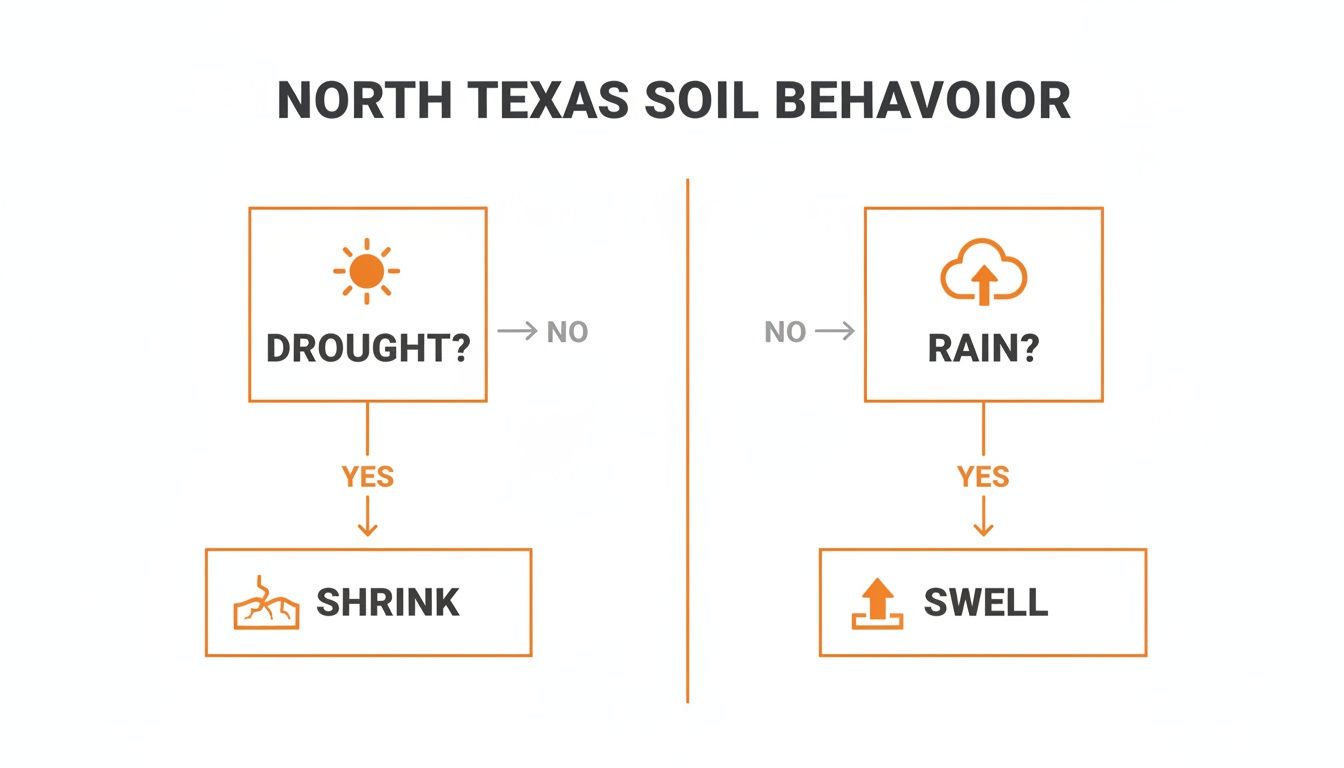
This cycle of shrinking and swelling is precisely why professional repairs have to account for both settlement (sinking) and heaving (lifting).
A Look at Common Foundation Repair Methods
To help you understand the landscape, here’s a quick comparison of the most common repair techniques used for homes in our area. Each one is designed for a different problem and type of foundation.
| Repair Method | Best For Fixing | Key Benefit | Typical Home Type |
|---|---|---|---|
| Steel Piers | Severe slab settlement | Reaches the deepest, most stable soil strata for maximum support. | Concrete Slab |
| Concrete Piers | Moderate slab settlement | A reliable and cost-effective method for stabilizing sinking areas. | Concrete Slab |
| Pier & Beam Adjustment | Sagging, bouncy, or unlevel floors | Levels floors and reinforces support without major slab work. | Pier-and-Beam |
| Mudjacking/Foam Injection | Voids under the slab (interior settlement) | Lifts sunken interior slab sections with minimal disruption. | Concrete Slab |
| Under-Slab Tunneling | Under-slab plumbing leaks | Provides access for plumbing repairs without destroying interior floors. | Concrete Slab |
Knowing which tool is right for the job is what separates a temporary patch from a permanent solution. Let’s dig into what these methods actually involve.
Stabilizing Sinking Slabs With Piers
For homes built on a concrete slab, the most common and effective fix for settlement is installing piers. Think of them as stilts for your house. They’re designed to bypass the unstable clay soil near the surface and anchor your foundation to solid, load-bearing ground deep below.
Two main types of piers are used in our region:
- Steel Piers: These are the heavy lifters. They are driven deep into the ground with hydraulic force until they hit bedrock or a layer of earth so dense it refuses to budge. This “point of refusal” ensures your foundation is resting on something truly stable.
- Concrete Piers: Pressed concrete pilings are another go-to option. They are pushed into the ground in sections until they reach the right depth and resistance. While they might not go as deep as steel, they are a proven and reliable solution for many homes.
The process involves digging small holes around the edge of your foundation, driving the piers, and then carefully lifting the settled parts of your home back toward their original position. It’s a powerful way to fix those sinking corners and restore your home’s structural integrity.
Restoring Pier And Beam Foundations
Many older North Texas homes have a pier-and-beam foundation, which means they have a crawl space underneath. The problems here look a little different—instead of slab cracks, you’ll see sagging floors, bouncy spots, or doors that suddenly won’t close.
Fixing these foundations is a totally different ballgame. A contractor goes into the crawl space to check on the piers (concrete blocks or wood posts) and the wooden beams they hold up.
The repair often involves a process called “shoring and shimming.” Using hydraulic jacks, the house is temporarily supported. This gives the crew room to replace rotted posts, add new piers for extra support, or slide thin steel shims on top of existing piers to make the floors perfectly level again.
Filling Voids With Mudjacking Or Polyurethane Foam
Sometimes the problem isn’t a sinking edge but a big empty space, or void, that has formed under the middle of your slab. This is often caused by a plumbing leak that washed away the supporting soil.
Two methods tackle this head-on:
- Mudjacking: The classic approach. A cement-like slurry is pumped through small holes drilled into your slab. This mixture fills the void and uses hydraulic pressure to lift the concrete back where it belongs. It’s great for leveling interior floors or even sunken driveways.
- Polyurethane Foam Injection: This is the modern, high-tech alternative. A structural foam is injected as a liquid, and it expands to fill every nook and cranny of the void. It hardens in minutes, lifting the slab with incredible precision. The drill holes are smaller, and the foam is much lighter than mudjacking slurry, so it doesn’t add extra weight to the soil.
The Clear Advantage Of Under-Slab Tunneling
When the problem is an interior plumbing leak under your slab, under-slab tunneling is a true game-changer. Instead of bringing a jackhammer into your living room to break through the concrete and your flooring, crews dig a tunnel from outside your home. They go underneath the foundation to get directly to the broken pipes.
This approach keeps the dust, noise, and mess completely outside. It saves your expensive tile or hardwood floors from being destroyed and lets plumbers and foundation crews work at the same time.
It can be a lot to take in, which is why our guide on when to call a professional for foundation repairs can help you figure out the next steps.
Budgeting for Foundation Repair: What to Realistically Expect
Let’s get right to it. The first question on every homeowner’s mind is, “How much is this going to set me back?” It’s a huge concern, and you need a straight answer to plan your next steps.
The reality is, there’s no flat rate for foundation repair. The final cost depends entirely on the extent of the damage and the specific fix your home needs. It’s less like buying an appliance and more like getting a custom solution built just for your property.
What Drives the Final Price Tag?
A professional will walk you through the specifics during an inspection, but knowing the key cost factors ahead of time will help you understand where the numbers on your estimate are coming from.
- Number of Piers: This is the big one. The more piers needed to properly support and lift your home, the higher the cost. A minor dip in one corner might only need a few, while widespread sinking could require a dozen or more.
- Type of Piers: Steel piers typically cost more than pressed concrete piers. Why? Because they’re driven much deeper to hit bedrock or a solid, stable soil layer, which gives you the best possible long-term support.
- The Scope of the Damage: Are we dealing with a simple settlement along one wall, or is the center of your slab heaving upwards? More complex issues mean more intensive work and materials, and that’s reflected in the price.
- Site Accessibility: If the crew has a clear shot at the work areas, the job moves faster and costs less. Things like big decks, concrete patios, or prized rose bushes can add labor hours and drive up the project cost.
Try to think of this not as a surprise bill, but as a critical investment in your home. You’re not just patching a crack; you’re protecting what is likely your biggest asset and stopping a small problem from turning into a structural nightmare.
Ballpark Costs and Timelines in North Texas
While every job is unique, I can give you some general ranges to help you prepare. For a typical North Texas home needing a moderate repair—say, installing 10 to 15 piers—homeowners should probably budget somewhere in the $8,000 to $20,000 range.
Of course, a very minor job could be less. But an extensive project that requires dozens of piers and tunneling under the slab can easily go higher.
Here in the Dallas-Fort Worth area, our expansive clay soil is almost always the culprit. Slab cracks are a serious red flag in about 75% of cases because this clay can swell up to 30% when it gets wet. If you ignore the signs, you could be looking at a fix costing anywhere from $10,000 to $50,000. This isn’t just a local issue; the global foundation repair market is expected to hit USD 3.0 billion by 2026, largely due to aging homes across the U.S. You can read more about the growth of the foundation repair market to understand the broader trends.
The Repair Process: A Quick Rundown
Once you give the green light, things tend to move pretty quickly. The timeline depends on the project size, but most residential jobs are wrapped up faster than you might think.
A standard pier installation project is usually done in just one to five days. Here’s what you can generally expect:
- Prep Work (Day 1): The crew shows up, lays down tarps to protect your landscaping, and starts digging small access holes where each pier will go.
- Installation & Lifting (Days 1-3): This is the main event. The piers are pushed deep into the ground with hydraulic rams. Then, the house is slowly and carefully lifted back toward its original level.
- Cleanup (Final Day): After the lift is done and everything is locked in place, the crew backfills the holes, tidies up the site, and does their best to leave your property looking like they were never there.
Proactive Maintenance to Protect Your Foundation
Knowing how to fix a foundation is one thing, but preventing problems before they start is where the real savings are. If you live in North Texas, you know our expansive clay soil is in a constant battle with your home’s foundation. Your best defense is a good offense: proactive maintenance.
These aren’t complicated or expensive chores. Think of it as being a good steward of your property. By working with our unique environment, you can keep the ground around your home stable and avoid those five-figure repair bills down the line.
Keep Your Soil Moisture Consistent
Our long, hot summers are notorious for drying out the clay soil. When it dries, it shrinks and pulls away from your foundation, creating a void that can cause your slab to sink and settle.
The most effective weapon against this is simple: a consistent watering routine.
You’re not trying to create a swamp. The goal is to maintain a steady, moderate level of moisture around the entire perimeter of your home. A soaker hose is the perfect tool for the job. Lay it out about 12 to 18 inches from the foundation wall and let it run on a low setting for a couple of hours.
How often you do this really depends on the weather. During a bad drought, you might need to water two or three times a week. It’s a small habit that makes a huge difference.
Consistency is everything. The soil should feel slightly damp to the touch, never muddy or waterlogged. This simple routine prevents the dramatic soil shrinkage that leads to foundation settlement.
Make Smart Drainage Your Priority
Just as too little water causes problems, too much water can be equally damaging. After a heavy Texas downpour, you need all that water to move away from your foundation, not pool up against it.
Poor drainage super-saturates the soil, causing it to swell with incredible force. This creates upward pressure, a phenomenon we call “heaving,” which can be just as destructive as settling.
Here’s your drainage checklist:
- Clean Out Your Gutters: Clogged gutters are a foundation’s worst enemy. They overflow and dump gallons of water right where you don’t want it. Make it a habit to clean them every spring and fall.
- Extend Your Downspouts: Your downspouts should carry water at least four to six feet away from the house. If they don’t, extensions are a cheap and easy fix.
- Check Your Landscaping Grade: Look at the ground around your home. Does it slope away from the walls? The rule of thumb is a six-inch drop over the first ten feet. If you see water pooling, you may need to bring in some dirt to build up the grade and encourage water to flow away.
Be Smart About Trees Near the House
We all love a big, shady tree, but their roots are incredibly thirsty. A single mature oak tree can pull 50 gallons of water a day out of the soil. When that tree is right next to your house, it can cause one side of your foundation to sink dramatically as the soil dries out.
If you have large trees within 20 feet of your foundation, you need to be extra vigilant with your watering routine in that specific area. When planning new landscaping, do yourself a favor and plant large species well away from the house.
For existing trees that are already causing trouble, a professional can install a root barrier. This is basically an underground wall that physically blocks the roots from growing underneath your slab, protecting it from that intense moisture drain.
Your Top Foundation Repair Questions, Answered
When you first suspect a foundation issue, a million questions probably race through your mind. It’s a stressful situation, and getting clear, straightforward answers is the first step toward feeling in control. Let’s walk through some of the most common concerns we hear from homeowners right here in the DFW area.
Knowing what you’re up against, from insurance quirks to finding the right crew for the job, makes all the difference.
Will My Homeowner’s Insurance Pay for This?
This is almost always the first question I get, and the honest answer is… probably not. But there are some big “ifs” to consider.
Standard homeowner’s policies are built to cover sudden, accidental damage. They’re not designed for problems that develop over time, which is exactly what happens with the slow-shifting, expansive clay soil we have all over North Texas. That’s usually considered a maintenance issue.
However, there are a few scenarios where your insurance might actually kick in. It all comes down to the root cause of the damage.
- A Sudden Plumbing Disaster: Imagine a pipe bursts under your slab. If that sudden gush of water erodes the soil and causes your foundation to drop, the damage might be covered as a direct result of that specific event.
- A Named Peril: If your policy covers events like flooding (and you have a separate flood policy) or earthquakes, any foundation damage directly caused by that event could qualify.
The key takeaway is that slow, gradual settlement from our local soil is rarely covered. It has to be tied to a specific, sudden, and covered event.
Can I Even Sell a House with Foundation Problems?
Yes, you can. It happens all the time. The one non-negotiable rule is that you must disclose it. Texas law is very clear on this; the Seller’s Disclosure Notice you provide to buyers has a specific section for structural problems.
When you find yourself in this situation, you really have two main paths forward:
- Fix It Before You List: This is often the best route. Repairing the foundation lets you list the house at its full market value. You’ll be able to hand the new owner the engineer’s report and a transferable warranty, which gives them—and their lender—major peace of mind.
- Sell It “As-Is”: You can also list the house as-is, but you’ll need to price it accordingly. Be prepared to lower the price to reflect the cost of the future repairs. This approach often works well for attracting investors or buyers who are specifically looking for a project.
How Do I Choose the Right Repair Company?
Picking the right contractor is easily the most important decision you’ll make in this whole process. Don’t rush it. You need a company that is certified, bonded, and fully insured. That’s your safety net.
A good company doesn’t just push a one-size-fits-all solution. They should take the time to walk you through why they are recommending a specific approach, give you a detailed written estimate, and be totally transparent about what to expect.
Look for a team with years of hands-on experience specifically with North Texas soils—they’re a unique challenge. And before you sign anything, ask about their structural warranty. A solid, lifetime transferable warranty tells you they’re confident in their work and will be around to stand behind it.
If you’re seeing signs of trouble, the best thing you can do is get a professional opinion. Black Beard Foundation Repair provides free, no-pressure evaluations to help you figure out exactly what’s going on with your home. Give us a call to schedule your assessment and get the answers you need. Learn more about our approach at https://blackbeardfoundationrepair.com.


