
Think of your home’s foundation as its anchor. It’s designed to keep everything stable and secure. But what happens when the ground it’s anchored to starts to shift and fail? That’s where foundation underpinning comes in.
What Is Foundation Underpinning
Simply put, foundation underpinning is a construction method used to strengthen and stabilize the foundation of an existing building. It’s like giving your house a brand new, much deeper, and more reliable set of legs to stand on when the original ground can no longer support its weight.
We’re not just patching a crack here. We’re digging down past the unstable soil to transfer the entire weight of your home onto solid, stable ground or even bedrock.
For anyone living in the Dallas-Fort Worth area, this isn’t just a hypothetical problem. Our infamous expansive clay soil is the main culprit. This soil swells up like a sponge when it rains and then shrinks and cracks during our long, hot droughts. This constant cycle of expansion and contraction puts incredible stress on a foundation, causing it to sink, shift, and fail.
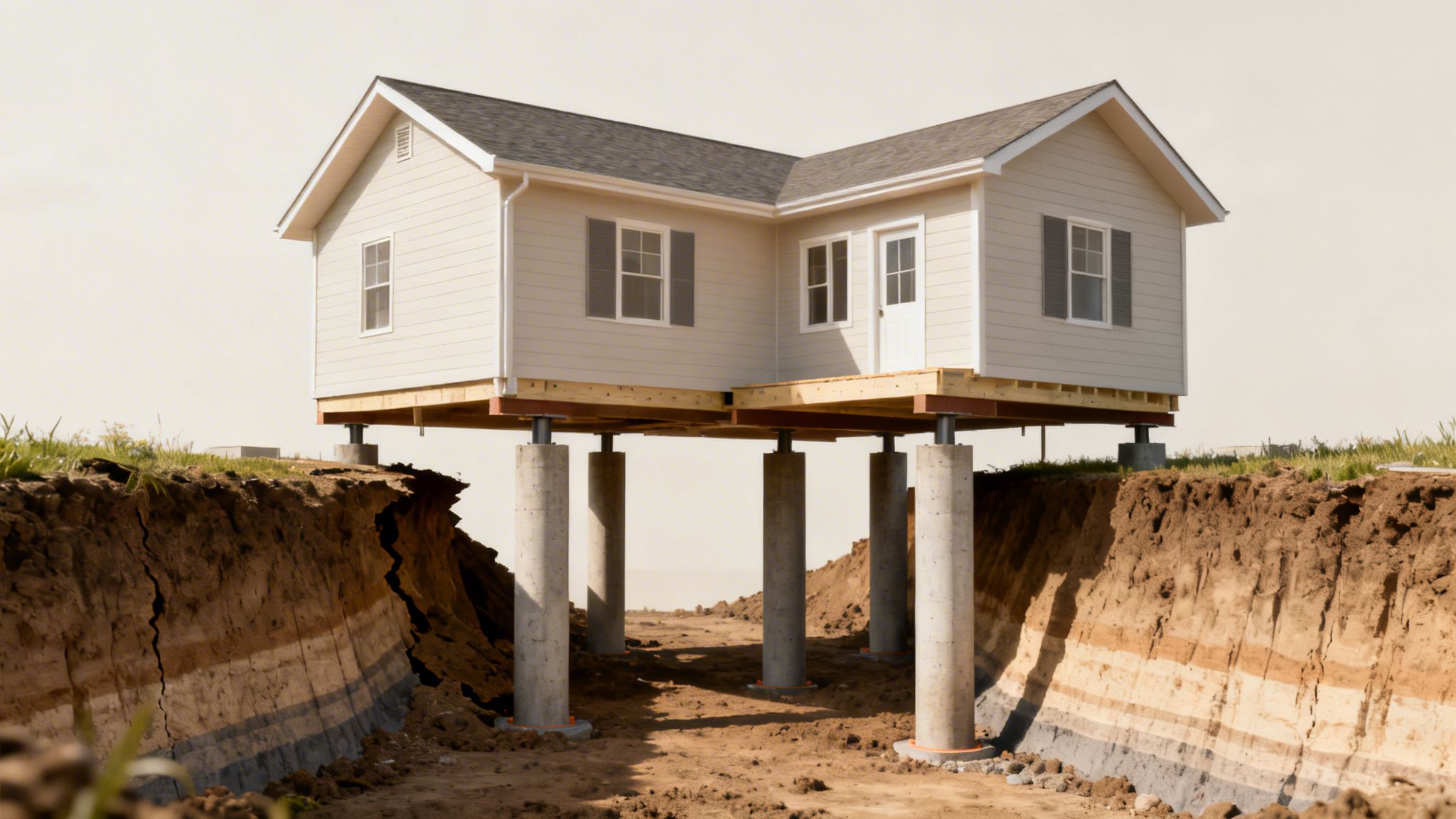
To make this concept even clearer, here’s a quick breakdown.
Foundation Underpinning At A Glance
| Concept | Description for Homeowners |
|---|---|
| The Problem | Your home’s foundation is sinking or settling because the soil directly beneath it is weak, unstable, or has shifted. |
| The Solution | We install new, deeper supports (like steel or helical piers) underneath the existing foundation. |
| The Outcome | The weight of your house is transferred from the unstable surface soil to a deep, solid layer of earth that doesn’t move. |
This table shows how underpinning provides a direct and permanent fix to the root cause of foundation failure.
A Permanent Solution, Not a Temporary Patch
It’s really important to understand that underpinning isn’t a quick fix or a cosmetic touch-up. Methods like patching cracks might hide the evidence for a little while, but they do nothing to solve the underlying issue. The foundation will just keep moving, and the cracks will come back.
Underpinning tackles the problem head-on. By installing supports deep into the earth, we bypass the problematic topsoil completely.
The weight of your home is permanently shifted to a load-bearing stratum—a layer of soil or rock that isn’t affected by those seasonal moisture changes. This process not only corrects the existing settlement but also protects your home from future movement.
Ultimately, this is about securing your biggest investment. It’s a proactive step that provides true peace of mind, ensuring your home remains safe and structurally sound for decades, no matter what the unpredictable Texas soil decides to do next.
Warning Signs Your Dallas Home Needs Underpinning
Your house has a way of telling you when something’s wrong. It usually starts with small, almost unnoticeable things. But when it comes to your foundation, those quiet whispers can quickly become a roar. Learning to spot the early warning signs is the key to catching a problem before it turns into a massive, expensive underpinning project.
The most obvious red flags are often on the outside of your home. Take a slow walk around the exterior and really look at the brick or stone. See any stair-step or zigzagging cracks climbing up the wall? That’s a dead giveaway. It means one part of your foundation is dropping lower than the rest, literally tearing the brick apart under the strain.
Inside, the clues can be just as telling, even if they’re easier to dismiss. Think about your doors and windows. Is there a bedroom door that suddenly won’t stay shut? Or a window that’s a real struggle to open and close? That isn’t just your house “settling”—it’s a sign the frames are being warped by a shifting foundation.
Interior Clues and Structural Shifts
The issues don’t end there. Check for gaps opening up between your walls and the ceiling, or between the walls and the floor. You might see crown molding pulling away or baseboards separating from the drywall. This is happening because the entire wall is being torqued and twisted by movement deep below.
And then there are the floors. Do you feel a slight dip or a slant when you walk across the living room? Try placing a marble on the floor; if it rolls to one side on its own, you’ve got visibly sloping or uneven floors. These aren’t just charming quirks of an older home—they’re direct proof of foundation settlement. You can learn more about what’s normal and what’s not in our guide on foundation cracks and settling.
In the Dallas-Fort Worth area, these problems are incredibly common. Our infamous expansive clay soil is the culprit behind issues in up to 25% of homes. This soil swells and shrinks dramatically, causing the very cracks and sinking floors that point to a need for professional help.
Global Trends and Local Realities
This isn’t just a DFW problem; it’s a growing issue worldwide. The global market for foundation repair services is expected to hit US$4.1 billion by 2033, thanks to aging homes and a better understanding of structural dangers. Here in North Texas, our unique soil and wild weather swings put us right at the center of that trend, making it critical for homeowners to stay alert.
If you’re noticing any of these signs—from a small crack to a floor that feels like a funhouse—it’s time to take action. Ignoring them won’t make them go away. It just gives the problem more time to get worse, guaranteeing a much bigger headache and a more expensive repair down the road. A professional evaluation is the only way to know for sure what’s going on and whether underpinning is the right fix to protect your home.
Picking The Right Tool For The Job: A Look At Foundation Underpinning Methods
Not every foundation problem has the same solution. Choosing the right underpinning method is absolutely critical for a permanent fix, and it’s something we take very seriously. Especially here in Dallas, where our notoriously shifty clay soil is the root of most issues, you need a solution designed to handle those unique challenges.
Think of it like this: you wouldn’t use a hammer to turn a screw. In the same way, we have to match the right underpinning technique to your home’s specific needs.
The goal is always to get past the unstable, reactive soil near the surface and firmly anchor your home to a solid, unmoving layer of earth deep below. How we get there, though, depends on the situation. Let’s walk through the most common and effective methods we use right here in North Texas.
Steel Push Piers
Picture powerful hydraulic jacks, but made specifically to hold up your entire house. That’s a good way to think about steel push piers. These are incredibly strong steel pipes that we drive, section by section, deep into the ground using hydraulic force.
It’s a straightforward process that requires some serious power. We push each pier segment through the problem soil until it hits either solid bedrock or a layer of earth so dense and compacted that it refuses to go any further. We call this the “point of refusal,” and it’s our indicator of true stability. Once all the piers are locked in place on that solid base, we carefully transfer the weight of your home onto them, lifting the foundation back towards where it’s supposed to be.
- Best For: Heavier homes where we can reach bedrock or a very dense soil layer at a reasonable depth.
- How They Work: They use the weight of the house itself as counter-force to drive the piers deep into the ground.
- Key Advantage: You get undeniable proof of stability. When the pier stops, you know it has hit something solid.
This chart shows some of the tell-tale signs that your home might need a solution like this.
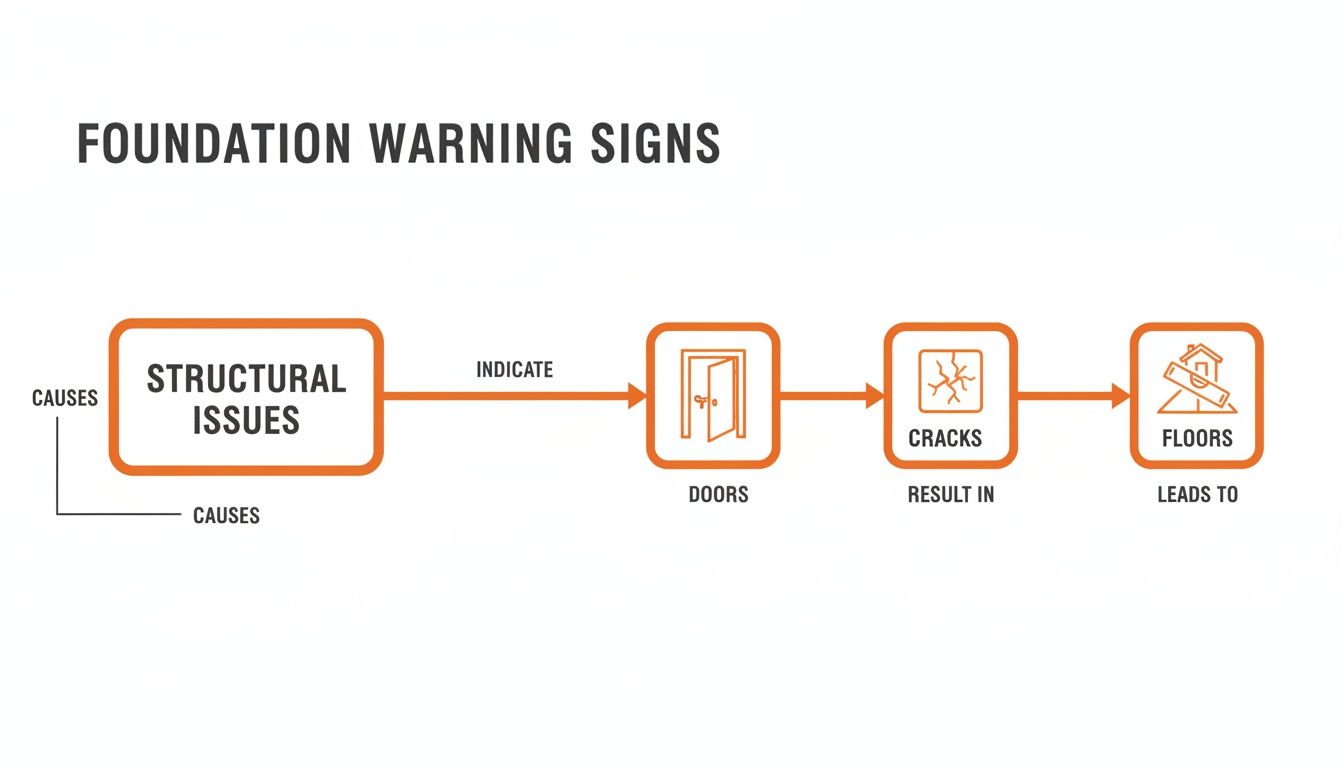
Cracks in the walls, doors that won’t close properly, and sloping floors aren’t separate problems—they’re all symptoms pointing back to a single culprit: a moving foundation.
Helical Piers
If push piers are hydraulic jacks, then helical piers are giant steel screws. These piers have one or more helix-shaped plates (they look like massive screw threads) welded onto the steel shaft. Instead of being pushed, these are screwed into the ground using a high-torque hydraulic machine.
As the pier turns, those helical plates pull it deeper into the ground. We constantly monitor the torque—the rotational force—it takes to turn the pier. When that torque hits a specific, pre-calculated value, we know the pier is firmly anchored in stable soil that can support the load. This is a huge advantage because it doesn’t rely on the weight of the house, making it a great option for lighter structures or additions. In tricky situations, getting the equipment where it needs to be can be a challenge, which is where specialized approaches come in. You can learn more about how we gain access beneath a slab foundation by reading about our under-slab tunneling services.
Helical piers are our go-to for lighter structures or when we’re dealing with soil where the stable load-bearing layer is exceptionally deep. The screw design gives us a predictable and verifiable capacity based on the installation torque.
Mass Concrete Underpinning
This is the old-school, traditional way of doing things. The process involves digging out sections of soil from underneath your foundation in a very specific, strategic sequence. Then, we pour concrete into those pits to create a brand-new, bigger, and stronger foundation base underneath the old one.
While it can be effective, it’s also far more disruptive, slow, and labor-intensive than modern piering systems. It means a lot more digging around your home, which tears up your landscaping and can really get in the way of your daily life. Honestly, with how precise and efficient steel and helical piers are, we rarely use mass concrete for residential repairs in DFW anymore unless the site conditions are truly unique and demand it.
Comparing Underpinning Methods for North Texas Homes
To make it even clearer, here’s a quick side-by-side look at how these methods stack up for homes in our area.
| Method | Best For | Pros | Cons |
|---|---|---|---|
| Steel Push Piers | Heavier homes (brick, two-story) on lots with accessible bedrock or a very dense soil stratum. | Reaches a verifiable “point of refusal” for guaranteed stability. Long-lasting steel construction. | Requires the weight of the house for installation, so not suitable for very light structures. |
| Helical Piers | Lighter structures, porches, additions, and areas with very deep or unpredictable stable soil. | Verifiable capacity based on installation torque. Less disruptive installation. Works in tight spaces. | Can be more expensive than push piers depending on depth and soil conditions. |
| Mass Concrete | Specific situations where piers are not feasible due to access or unique structural loads. | Uses common materials and has been a trusted method for decades. | Extremely invasive and labor-intensive. Takes much longer and creates a bigger mess. |
Choosing the right method isn’t just about the soil; it’s about your home’s construction, your property’s layout, and creating a permanent solution that gives you peace of mind.
The Underpinning Process From Inspection To Completion
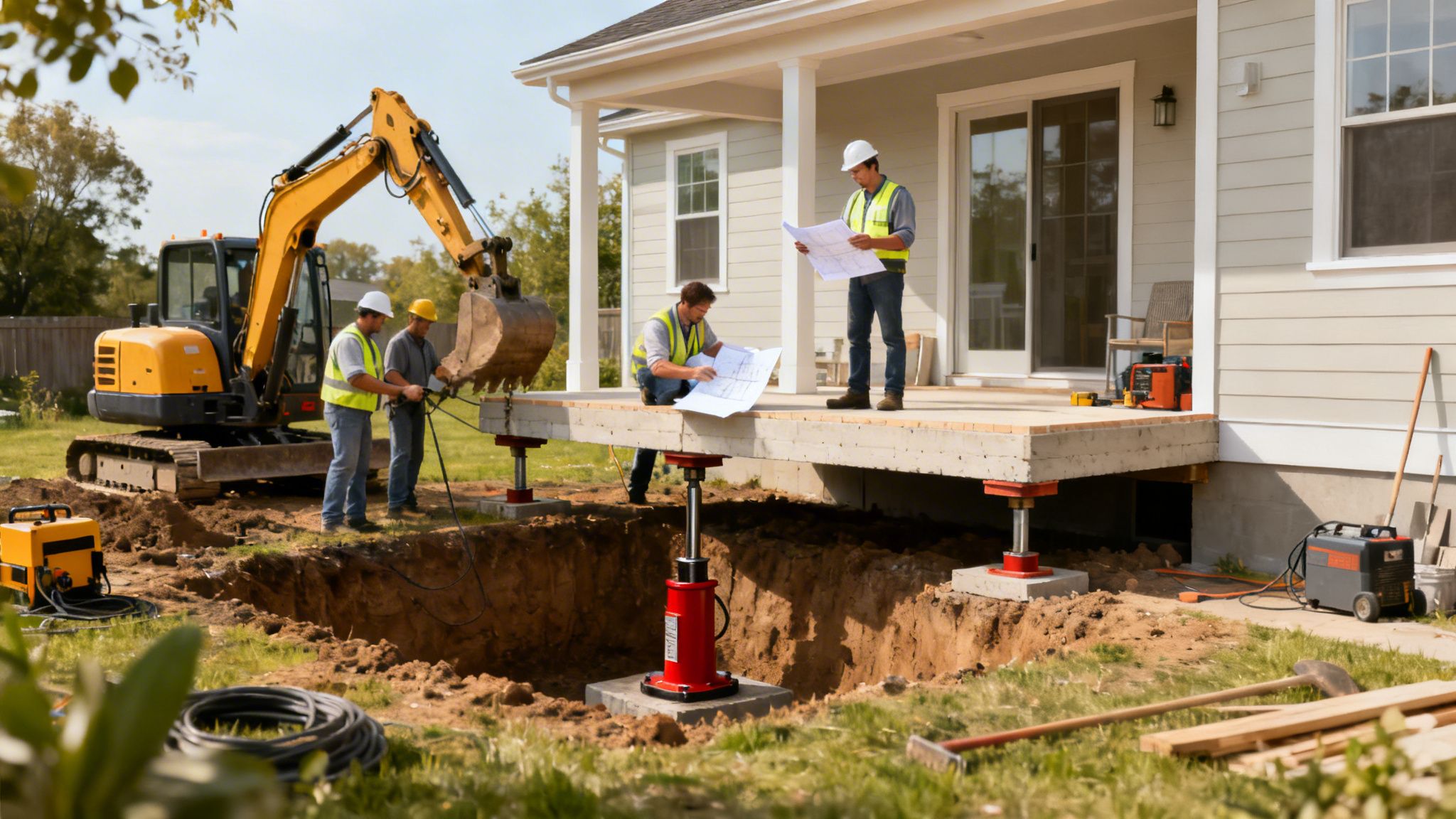
A foundation repair project can feel like a huge deal, but breaking it down into clear steps really helps. When you know what to expect, the whole thing feels less intimidating and more like a straightforward plan to get your home back on solid ground. The entire process is methodical, handled by professionals, and designed to cause as little disruption to your life as possible.
It all starts with a detailed structural assessment. A foundation repair expert will come to your home, get their eyes on the damage, figure out what’s causing the problem, and take precise elevation readings. This initial evaluation is the most important step—it’s what we use to build a repair plan that will actually last. Our foundation inspection checklist for DFW homes can give you a great idea of what we’re looking for.
Creating the Blueprint for Repair
After the inspection, we draw up a detailed engineering plan. This isn’t a cookie-cutter solution. The plan calls out the specific type of piers we need to use (like steel or helical), exactly where they need to go, and how deep they must be driven to hit stable soil. This blueprint is our roadmap, ensuring every part of the job is planned for success from the start.
Once you give the green light, we take care of the logistics, including pulling any necessary city permits. With the paperwork handled, the real work begins on-site, starting with carefully prepping the areas around your foundation.
The most critical phase of any foundation underpinning project is the planning stage. A precise engineering plan, based on a detailed inspection, is the difference between a temporary patch and a permanent solution that secures your home for decades.
Installation and Restoration
The installation phase kicks off with strategic excavation. We dig small, precise holes around your foundation right where the piers are planned to go. Our crews are trained to work carefully to keep your landscaping as undisturbed as possible.
Next, the piers go in. Depending on the plan, they’re either driven or screwed deep into the earth until they hit bedrock or a solid layer of soil that can bear the load. They don’t stop until they hit refusal—that’s how we know they’re on solid footing.
With the piers anchored, a synchronized hydraulic lifting system is set up. We use it to gently and evenly raise the parts of your foundation that have settled. This is a slow, careful process; the last thing you want to do is create more stress on the house. Once the home is back in alignment, we lock the piers in place and backfill the excavated areas.
Finally, our team does a full site cleanup, leaving your property looking tidy. From the first shovel in the ground to the final handshake, we manage the entire project to be as efficient and transparent as possible, so you feel confident and in the loop the whole way through.
So, What Does Foundation Underpinning Actually Cost in Dallas?
Let’s get straight to the question on every homeowner’s mind: what’s the price tag on something like this? There’s no simple, one-size-fits-all answer, but we can definitely break down what goes into the final number. The cost is a direct reflection of what your specific home needs to be made safe and stable for the long haul.
A good way to think about it is like buying tires for your car. The final bill depends on how many tires you need and what kind your car requires. For foundation underpinning, the biggest cost factor is the number of piers needed to get your home back on solid ground. A small, isolated problem might only take a few piers, but more widespread settling will naturally require a more comprehensive solution.
Key Factors That Drive the Cost
Several things come together to determine the final estimate for an underpinning project. Each one adds to the labor, materials, and overall complexity of permanently fixing your foundation.
- Depth to Solid Ground: How far down do we need to go? The deeper we have to push the piers to hit bedrock or a stable soil layer, the more it adds to the material and labor costs. Dallas soil can be tricky and deep.
- Number of Piers: This is the big one. A structural engineer will create a plan that maps out exactly how many piers are needed and where they have to go. More piers mean a bigger budget.
- Getting to the Work Area: Is your foundation easy to access? Things like tight side yards, beautiful landscaping you want to preserve, or existing concrete patios and decks can make the digging and installation process more complex and time-consuming.
Realistic Budgets and a Word on Insurance
For a typical home in the Dallas-Fort Worth area, you can generally expect underpinning costs to fall somewhere between $10,000 and $30,000. It’s a significant investment, but it reflects the intensive work and specialized materials required to give you a permanent fix. The underpinning industry is massive—the residential market alone was valued at USD 1.15 billion back in 2019—which just shows how critical this work is for protecting home values. You can find more details about the foundation repair market growth on natlawreview.com.
Now, what about insurance? It’s one of the first questions we get, and for good reason.
Generally speaking, standard homeowner’s insurance does not cover foundation problems that come from natural soil settlement, drought, or shoddy original construction. However, if the damage is a direct result of something your policy does cover—like a sudden plumbing leak that washes out the soil under your slab—you might be in luck.
The best advice is to pull out your policy and talk directly with your insurance agent. Sometimes, even if the underpinning itself isn’t covered, the work needed to access a covered plumbing leak might be. Figuring out these details is a crucial step in planning and budgeting for this essential home repair.
How To Choose The Right Foundation Repair Contractor
Hiring the right contractor is, without a doubt, the most critical decision you’ll make when it comes to underpinning your home. The quality of the repair, how long it lasts, and your own peace of mind are all riding on this choice. This isn’t just about finding the lowest price; it’s about finding a skilled partner who will protect your most valuable asset.
Think of it like you’re hiring a specialist for a high-stakes job—because you are. The first step is to check the basics and make sure they’re even qualified to be in the running.
Vetting Your Potential Partners
Before you get into the nitty-gritty of a repair plan, you need to see their credentials. Any professional, reputable contractor will have this information ready and won’t hesitate to share it. Don’t just take their word for it; verify everything.
- Licensing and Insurance: Ask for proof of their license to operate in your city and, just as importantly, their general liability insurance. This is what protects you if an accident happens on your property.
- DFW Experience: How long have they been digging in Dallas-Fort Worth soil? Our expansive clay is a beast of its own, and you want a team that has spent years, not months, dealing with its specific challenges.
- Written Estimates: A verbal quote is worth nothing. Always get a detailed, itemized estimate in writing from at least three different companies so you can compare the proposed work, materials, and total costs.
A lifetime warranty is the gold standard for foundation underpinning, but not all warranties are the same. Dig into the details. Is it transferable to the next homeowner? Get a written copy and read the fine print to understand exactly what is—and isn’t—covered.
Spotting Red Flags
Beyond the paperwork, pay close attention to how the contractor acts and communicates. A true professional will walk you through their findings with hard data, like the elevation readings they took during the inspection. They should be able to clearly explain why they’re recommending steel piers over helical piers (or vice versa) and justify where each one needs to go.
Be very skeptical of high-pressure sales tactics or anyone rushing you to sign a contract on the spot. An expert is confident in their assessment and will give you the information and time you need to make the right call. Choosing the right partner is what turns this major repair into a lasting investment that will secure your home for decades to come.
Your Top Underpinning Questions, Answered
Alright, we’ve covered the nuts and bolts of what underpinning is and how it works. But I find that homeowners usually still have a few practical questions on their minds before they feel truly comfortable with the process. Let’s tackle those head-on.
One of the first things everyone wants to know is, “How long will this repair actually last?” It’s a fair question. The great news is that a professionally designed and installed underpinning system is considered a permanent solution. Think of it this way: we’re no longer letting your house rest on that shifty, expansive clay near the surface. Instead, we’re anchoring it to solid, stable ground deep below.
That’s precisely why a reputable company will offer a transferable lifetime warranty. It’s not just a sales gimmick; it’s a statement of confidence that the fix is engineered to last for the life of your home.
What About My Daily Life? And My Home’s Value?
Another big worry is the mess and disruption. People picture their yard being torn up for weeks. In reality, modern underpinning methods are surprisingly clean and targeted. The work is usually confined to small, specific areas around your foundation, so the impact on your daily routine is minimal. It’s far less of an ordeal than most people think.
And the final, crucial question: how does this affect my property value? A failing foundation is a huge red flag for potential buyers. It can kill a sale instantly or force you to accept a drastically lower offer.
A professionally underpinned foundation, on the other hand, flips that liability into a powerful asset. When you can hand a potential buyer a transferable lifetime warranty, you’re providing concrete proof that the home is structurally secure. It’s the kind of peace of mind that closes deals.
Ultimately, underpinning isn’t just about stopping cracks from getting worse. It’s a smart investment that protects your home’s value and marketability for the long haul.
A stable foundation is the bedrock of a safe, valuable home. The team at Black Beard Foundation Repair combines deep local knowledge with proven technical expertise to solve your foundation issues for good. If you’re seeing the signs, don’t wait. Schedule your free, no-obligation evaluation today.


